

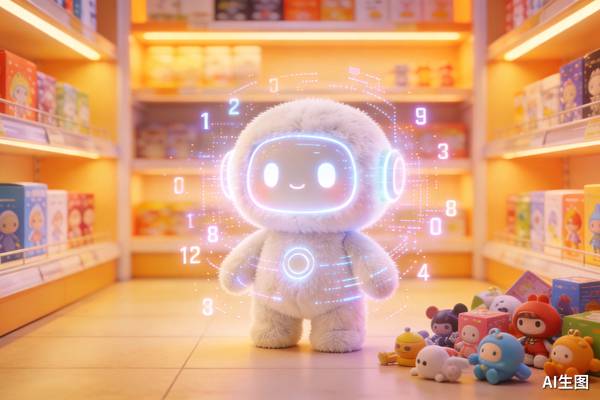
Is the AI toy sector making a high-stakes bet on the next Pop Mart?
A blind box costs an average of 99 yuan, but a chatty Tom cat or plush bear can be priced as low as 399 yuan, with the highest price reaching 3,000 yuan.
Compared with trendy toys, the price of AI toys has increased dozens of times, making it a highly profitable business. Different from offline stores that require heavier investment, AI toys are mainly booming online.
According to Taobao’s 2025 annual data, the transaction volume of AI toy products increased by more than 1600% year-on-year, and AI companion dolls were also selected as one of the top ten products of the year on Taobao.
Recently, Pinduoduo officially added the AI toy category and fully launched merchant recruitment. In Pinduoduo’s recruitment announcement, AI toys can get more abundant traffic support during the “Double 11” event and in daily searches.
But on the other side of the coin, investment in the entire AI toy track has cooled down significantly, with products facing severe homogenization and persistently high return rates.
As platforms are vying to put AI toys on their shelves, will it become the next Pop Mart, or just end up as a short-term gold-rush trend?
AI drives prices up dozens of times, Pinduoduo also joins the “gold rush”
Compared with the 99-yuan blind box, AI toys have the obvious attribute of high unit price per customer. Tech Planet saw at an offline AI trendy toy store that the price of a Tom cat AI toy, after being embedded with a large model, climbed up to 1999 yuan at most. At present, there are still few AI toys with IP authorization, and most products focus on emotional companionship, introducing personas with different emotions.
Different from offline channels, buyers of AI toys on e-commerce platforms are mostly users from the parent-child market.
Taobao and Tmall were the earliest to make layouts in the AI toy sector. As early as April 2025, among the four super tracks released by the toys and trendy toys industry of Taobao and Tmall, there were emotional value, IP physicalization, male economy and AI toys, and it is expected that these four major fields will become the main growth points of the industry in the next five years.
JD’s strategy focuses more on “technology empowerment”. It launched the self-developed “embodied intelligence” platform JoyInside to provide the “brain” for AI toys. JD’s strategy is to build an integrated embodied intelligence ecosystem of “hardware + software + services”, attract brands to access through its self-developed AI platform, and launch self-developed AI toys.
Caption: Pinduoduo AI toy recruitment content
For Pinduoduo, AI toys have higher unit price per customer. In the recruitment information released to merchants, Pinduoduo also mentioned that “the new opportunity for AI toys is that AI functions can support a 300% premium, allowing merchants to say goodbye to 9.9-yuan free shipping products”. Take the current popular online product Fu Zai as an example, its lowest price is 399 yuan. In addition, users in the sinking markets “beyond the Fifth Ring Road” are also the main audience of AI toys.
The most illustrative data comes from the Spring Festival holiday period. During the 2026 New Year Shopping Festival, the transaction volume of the AI toy category on Taobao and Tmall surged 500 times year-on-year, and a large part of the increment came from county and township markets.
A practitioner in the AI toy industry told Tech Planet that when people in first-tier cities buy AI toys, their decision-making logic tends to be educational investment or early adoptions of new technologies, and the unit price can reach thousands or even tens of thousands of yuan, as parents will research the capabilities of the large model, dialogue quality and educational content. The decision-making logic in sinking markets is simpler: the product is cheap, can talk to children, and is better than ordinary toys.
According to data disclosed by the Ministry of Industry and Information Technology, the scale of China’s AI toy market reached 29 billion yuan in 2025, which the industry defined as the “first year of AI toys”, and the market size is expected to reach 34.2 billion yuan in 2026.
Gifting has become the main purchasing scenario. After this year’s National Day small vacation, data disclosed by some manufacturers shows that the sales volume in the first half of this year has exceeded that of the whole of last year. Especially in places with developed toy supply chains such as Dongguan and Yiwu, some merchants have already made huge profits.
A leading AI toy manufacturer told Tech Planet that its products are embedded with the Doubao large model for the domestic market, and ChatGPT for overseas markets. The ex-factory price is about 100 yuan, and 70% of its customers are from overseas markets. According to him, last year he was the only manufacturer that transformed from ordinary plush toys to AI toys, and this year more than a dozen manufacturers are engaged in this business.
The traditional toy industrial belts have also ushered in a performance boom. As the most developed region for AI toys, the Chenghai Toy Association once disclosed to the public that the export proportion of AI toys of local toy enterprises above designated size has increased from less than 10% in 2024 to about 30% in 2025. In 2025, the total output value of Chenghai’s toy industry exceeded 500 billion yuan.
High return rate and homogenization make it hard to produce the next Pop Mart
But on the other side of the coin, a large number of profit-seeking brands are pouring into this track. Behind the short-term explosive growth, repurchase rate and user experience have not improved synchronously.
A parent who bought an AI toy described his observation to Tech Planet: the AI toys on the market are severely homogenized, and their functions basically revolve around several fixed modules: eyes made of screens, popular science functions packaged with AI voice assistants and personas, simple actions such as dancing, waving and twisting. More advanced products add obstacle-avoiding movement based on the technology similar to that of sweeping robots, coupled with limited personality development and growth evolution, as well as marginal functions such as photography and diary recording.
“It feels like all products are basically within this framework. Every day I see new products popping up, but when I take a closer look at their functions, I feel a little disappointed,” said the parent mentioned above.
In addition to homogenization, the high return rate also remains at a high level. After the novelty-seeking demand fades, AI toys quickly become gadgets that gather dust on desks. Multiple users who bought AI toys mentioned to Tech Planet that the network connection is unstable, and it even takes a very long time to complete the activation and network connection process. One user added that she recently bought a 599-yuan walulu, and it took her a long time just to connect to the network, activate the device and maintain a stable network signal for dialogue. She still couldn’t figure it out in the end, so she chose to return it.
Caption: Offline AI toy store, photographed by Tech Planet
Industry reports show that the return rate of AI toys has long remained above 50%. On e-commerce platforms such as Taobao, JD and Pinduoduo, in order to reduce the return rate, some trendy toy enterprises implement conditional return and exchange policies, that is, products cannot be returned once they are connected to the network and activated. But this measure will also lead to a decline in sales.
The aforementioned manufacturer told Tech Planet that there is a set of data circulating in the industry: a top content influencer with tens of millions of fans sold more than 10,000 units of a certain AI toy in a single live stream, with a 50% commission ratio, but the subsequent return rate was as high as 60%.
Although compared with the overseas market, the domestic market is dominated by AI plush toys, which seems to be closer to the trendy toy track, in fact, it is difficult to define AI trendy toys as the next Pop Mart.
From the perspective of business model, the barriers of trendy toys lie in IP and aesthetics, while the barriers of AI toys lie in large model interaction capabilities, cost control of network connection and computing power, and subscription service ecosystem.
At present, AI toys mainly include two modes. One is more similar to the game industry: buying hardware is only the starting point, and continuous payment is the closed loop of the business model. Take Fu Zai as an example, the daily dialogue duration is 30 minutes. If you need to increase the daily dialogue duration, you need to pay extra fees. Fu Zai adopts the “hardware purchase + subscription payment” mode: the product provides about 24 minutes of free interaction time every day, and users need to buy a monthly card or annual card for extra time. The VIP annual card costs 199 yuan, and the SVIP (unlimited energy value) annual card costs 299 yuan.
The other is the one-time buyout mode: users pay for the hardware at one time and no longer generate continuous subscription expenses. Such products are usually more expensive. Take a Tom cat toy as an example, its price is 1999 yuan.
Sun Zhaozhi, founder of Fu Zai, once stated publicly that the hardware itself has a healthy gross profit that can cover the hardware cost. Software costs include Token cost, cloud service cost, RTC technology fee, etc. Enterprises will cover these costs through membership subscription fees and value-added service income.
He also mentioned that the Token cost of Fu Zai does not account for a high proportion, because manufacturers will conduct model shunting: low-cost models specially optimized for role-playing are used for daily dialogues, and the most expensive models are only called for high-reasoning tasks such as “personality evolution”, which account for a very low proportion of all tasks.
Price war kicks off, 99-yuan AI toys sell explosively on e-commerce platforms
A person in charge of an AI toy manufacturer told Tech Planet that parent-child customers are still the main market. On the one hand, the current voice interaction capability of AI trendy toys is difficult to meet the needs of adults, and the experience is even worse than just continuing to use mobile phones; on the other hand, AI toys focus on the attribute of companionship, but it is difficult for adults to let down their guard and chat about their thoughts and secrets with an AI toy.
In addition, the person in charge said that different from the trendy toy industry, products in the form of electronic pets usually sell better, most of which are AI toy cats, because their ears and tails can shake when touched, which can attract children’s attention faster.
There are few well-known IP co-branded products in current AI toys. The core reason is not that there is no intention for cooperation, but that the IP parties dare not authorize, and the manufacturers cannot meet the requirements.
The most direct obstacle is the conflict between the “uncontrollability” of AI and the “persona obsession” of IP. The content generated by AI large models is random, while well-known IPs have gone through years of operation, with strict settings for character personality, speaking style and values. If an AI toy printed with the character image says something inappropriate, the damage to the IP may be fatal.
This is not an unfounded worry. Hasbro, the parent company of Peppa Pig, has specially set up an AI team, spent a year building a contract framework, and clearly stipulated that at present it only develops enterprise-end applications, not directly facing consumers, because AI interaction for consumers is “extremely risky”.
Traditional trendy toys sell “the pleasure of possession” and “collection value”, while AI toys sell “companionship”. The underlying logic behind the sharp rise in the value of Pop Mart’s LABUBU is scarcity. However, AI toys rely on general large models, with highly similar interaction logic, so their scarcity is diluted, and their premium capability is not in the same dimension as traditional trendy toys.
A user who bought Walulu told Tech Planet that it is an AI toy that looks very much like a real pet cat, but after receiving the product, the huge zipper and the built-in movement inside seem to tell him that the target users are children under six years old. In addition, the price of AI toys now needs to be controlled within the acceptable range of ordinary parents, so the hardware and models can only be relatively low-quality, and the final dialogue experience is very unsatisfactory.
The upstream order volume can also reflect the situation more intuitively. A factory owner in Guangdong told Tech Planet that his factory has received many proofing orders for AI toys recently, and the mass production quantity is basically stuck at the minimum order quantity, and it is difficult to get reorders. The main reason is that the interactivity and sense of companionship are not strong enough.
An AI toy practitioner told Tech Planet that the industry needs products like Disney’s “Olaf”, otherwise it will be difficult to make a breakthrough. Most of the current AI toys are old functions that are fitted with Doubao / Qianwen, and then stuffed into a toy shell, just like a Tmall Genie wearing doll clothes. The functions of AI toys on the market are all the same, and the competition only depends on whose product is more convenient to use and whose appearance is more attractive. Large leading manufacturers are standing at the top of the trend to attract investment, while small and medium-sized manufacturers sell movements to downstream parties for adaptation. Almost all of them have overstocked inventory, and only a few of them have real sales and normal capital flow.
“Olaf” was jointly developed by Disney, NVIDIA and Google DeepMind. Compared with the “screen eyes + voice assistant + simple actions” mode, all technologies of the Olaf robot serve one thing: to make you believe that it is Olaf himself, so that users are immersed in the character, rather than just using an AI function.
But this also exposes its limitations. Olaf cannot really have autonomous conversations at present. What it plays are pre-recorded lines by voice actors, which are triggered by backstage operators according to the on-site situation. That is to say, its “intelligence” is performed, not a general capability.
At the beginning of the AI toy boom, the price of a product was basically set at 399 yuan. But in the past year, AI toys priced at around 99 yuan have sold explosively on e-commerce platforms. In the absence of absolute core competitive barriers, the price war has become the most direct signal. Brands such as Fu Zai, compared with product innovation, have now started selling peripheral products such as doll clothes in their stores.
The final form of AI toys is still being explored, and the industry is waiting for the arrival of a critical point.
This article is from the WeChat official account “Tech Planet” (ID: tech618) published with authorization from 36Kr
