

Front page
InterviewCX Intelligence27m · 09:01 BST · 3 min read
Why Fragmented Retail Media Data Damages Customer Intelligence
Retail media networks offer brands a growing volume of campaign data, but inconsistent attribution, reporting speeds and definitions are making it harder to build a dependable customer view. CX leaders must connect these signals before investment decisions become distorted.
The proliferation of retail media networks is exposing a growing disconnect between campaign reporting and customer insight.
Brands may receive valuable performance data from individual platforms, yet differences in attribution, timing, and definitions can make those results difficult to reconcile at a wider level.
To ensure success, CX leaders should assess whether their current data infrastructure can connect these signals to support coordinated customer engagement.
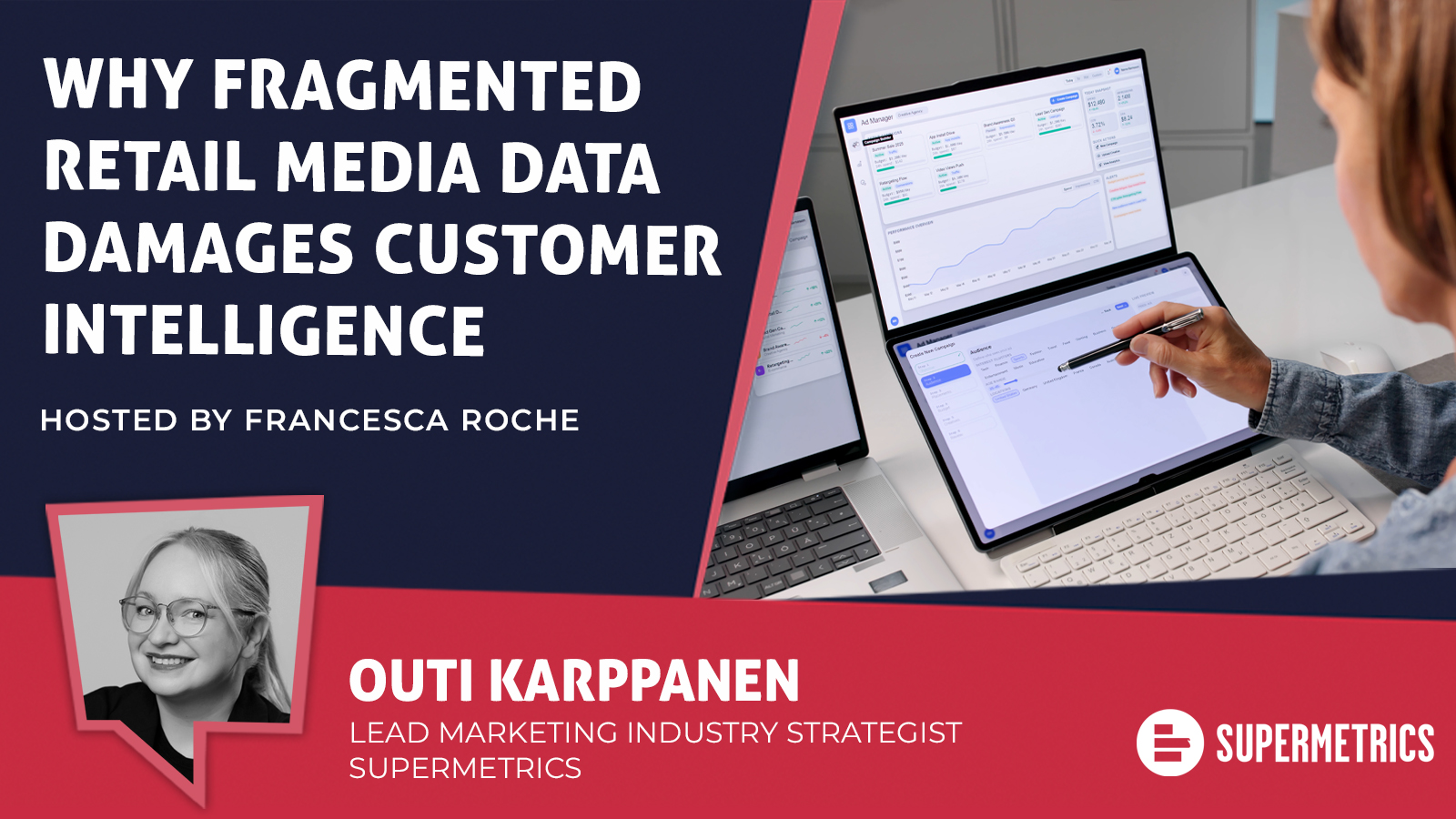
Speaking to CX Today,Outi Karppanen, Lead Marketing Industry Strategist at Supermetrics, argued that brands may understand performance within an individual network, but struggle to combine those findings into one reliable view.
“At the same time, they are getting valuable insights, but it is also disconnected.”
The Cost of Disconnected Insight
The expansion of retail media is highlighting the reality that having more data does not equate to a clearer understanding of customers.
In fact, <a href="https://supermetrics.com/marketing-data-report-2026” rel=”nofollow noopener” target=”_blank”>Supermetrics revealed only 30% of marketers are confident that their data is connected, highlighting the gap between the volume of information available and its usefulness.
With many brands often left working across multiple reporting environments with different definitions and measurement approaches, turning campaign data into a consistent, actionable view of customer behaviour is becoming increasingly difficult.
Today, retail media networks can define standard metrics differently and shift report timing, making direct comparisons difficult.
While some networks provide detailed results quickly, others deliver aggregated or delayed data, creating challenges for teams trying to understand how channels are influencing behavior.
“The fragmentation is both the defining of metrics and the speed of when you’re getting that data. It’s not real time.” Karppanen notes.
This creates a risk for investment decisions, particularly when marketers are comparing performance across networks.
“Budget follows the most generous attribution, not the customer’s actual being influenced.”
It’s data also found that half of marketers are waiting one to three business days for answers from data teams, meaning insights arrive after the opportunity to adjust a campaign has passed.
Without a connected journey view, brands can struggle to distinguish platform influence, whilst reporting can become a significant operational burden.
Teams that spend more time on manual data tasks have less capacity to understand why customers responded and what those insights should mean for the wider CX.
Start With Your Customer Outcomes
To fix this manual issue, the first step for brands is to build a measurement framework around the customer outcomes they need to understand.
“First, they should decide which customer outcomes actually need to understand,” Karpappen explained.
“Not what data do you happen to have, but what do you actually need.”
From here, brands can create a consistent internal language so retail media performance can be assessed alongside activity.
“Have a common taxonomy that lets you then normalize the retail media data against your own channels,” she said.
Centralizing these sources in a shared data warehouse can give teams a dependable foundation for customer intelligence, making it easier to trace a metric and identify the attribution model.
Because a centralized dataset does not automatically create trustworthy insight, teams still need to understand the definitions and assumptions behind the numbers.
From here, AI can help process large datasets, identify patterns, and investigate why particular products or channels performed differently, shortening the time between receiving data and resolution.
Despite its success, however, AI still requires human oversight because it cannot determine whether an attribution model is appropriate or a pattern has meaningful CX implications.
“You can get instant access,” she highlighted.
“It crunches up the numbers for you in minutes, depending on how much data you have. Then, the human can make the decisions.”
With a trusted data layer and clear measurement standards in place, AI can reduce reporting workload while leaving marketers and CX leaders to interpret findings and decide what actions to take.
rate this storyhelps rank stories across CX Today
Read nextordered by techtelligence · every pick explained
same beat · CX Intelligence
Salesforce Loops Deal Targets CX Problems Before They Hit
13 Oct 2026matches this topicHeathrow, Google and the ICO on Smarter, Safer CX Data13 Oct 2026matches this topicYour Decision-Making Strategy is Now on a Timer9 Oct 2026
More from the CX Intelligence desk

Salesforce’s latest acquisition points to a bigger ambition for Tableau and Agentforce. The vendor is helping businesses identify the causes of customer experience failures, rather than simply measuring their effects. But can enterprises trust AI to recommend the next move?
Rhys Fisher · 13 Oct 2026News
Heathrow, Google and the ICO on Smarter, Safer CX Data
As AI agents take on more customer-facing work, CX leaders must connect reliable data, clear consent, and governance controls. New moves from the ICO, Google and Heathrow show why explainable insights and accountable automation now determine whether personalization earns trust.
Francesca Roche · 13 Oct 2026News
Your Decision-Making Strategy is Now on a Timer
AI is becoming the customer journey’s discovery and decision layer. This week’s reports show why CX leaders need real-time, governed data, accurate product information and human escalation paths to turn automation into trusted, competitive experiences at scale.
Francesca Roche · 9 Oct 2026
