

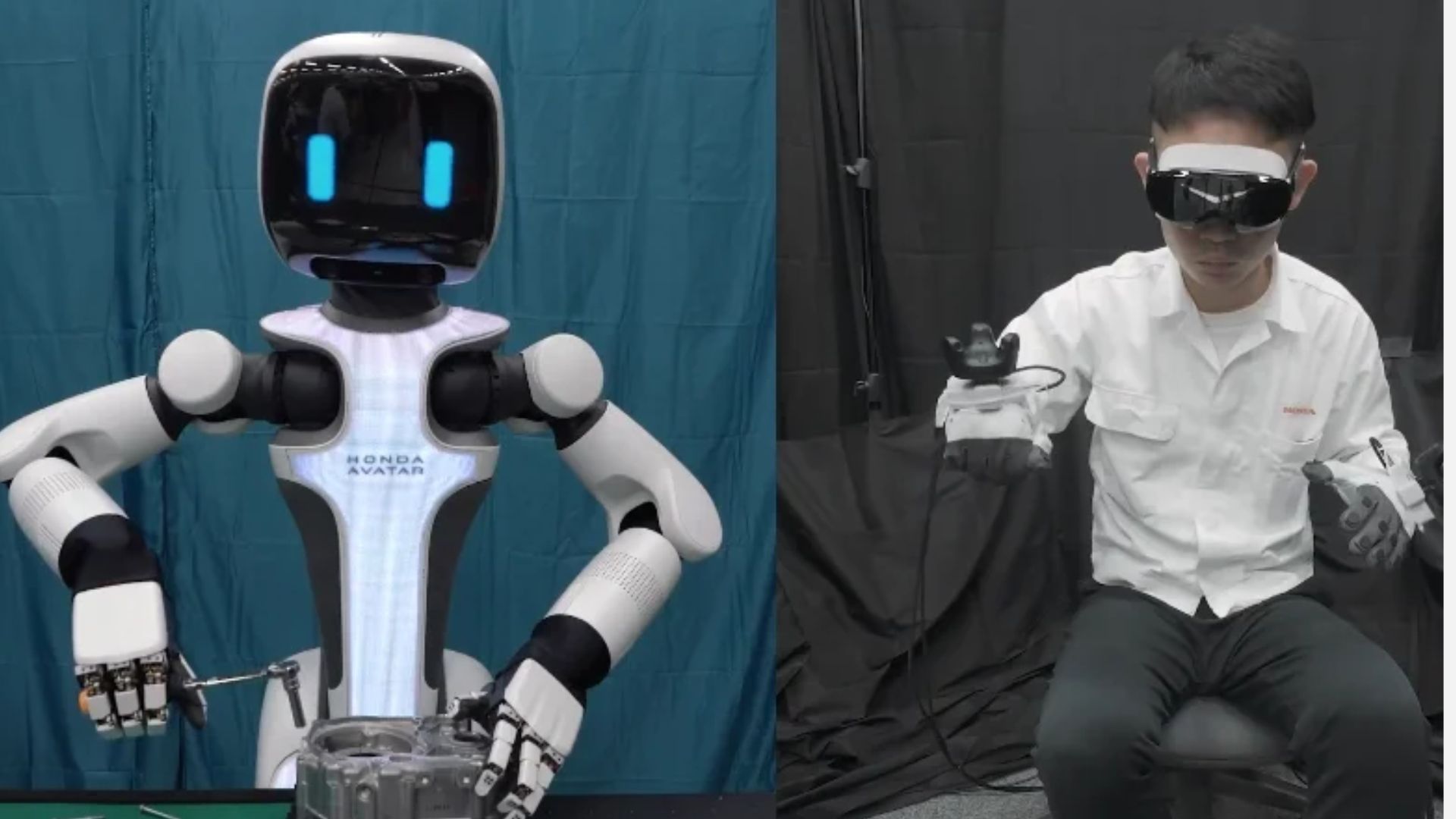
Honda has demonstrated a robotic hand designed to tackle tasks requiring human-like precision and strength. The demonstration took place at CEATEC 2026 in Japan, showcasing technology that could let people perform physical work remotely.
The Japanese automaker’s Honda Avatar Robot combines a multi-fingered hand with an assistance system that helps users control its movements. Honda envisions applications ranging from equipment maintenance and medical support to disaster response and space operations.
The demonstration highlights a persistent challenge in robotics. Machines can increasingly navigate complex environments, but manipulating everyday objects reliably remains difficult.
Hand built for precision
Honda’s human-scale robotic hand features 16 actuated joints, with each joint reaching continuous speeds of up to 180 degrees per second. That movement allows the mechanism to perform delicate operations while retaining the strength needed for demanding physical tasks.
Each fingertip can apply up to 50 newtons of force continuously. Six-axis force sensors measure forces and torques at the fingertips, helping the system interpret physical interactions.
The hand also incorporates 288 tactile-sensor channels distributed across its fingers and palm. These sensors provide detailed contact information, helping operators handle objects with greater control.
More from AI and Robotics
See All
AI and RoboticsOpenAI says its own models helped identify employee arrested over hidden office bug
AI and RoboticsGemini 4 Argon cuts quantum computing costs 100-fold, advances fusion and robotics
AI and RoboticsRepurposing e-waste: ‘PhoneBot’ uses unused smartphones as robotic brains
AI and RoboticsVideo: Humanoid robots help manage traffic, spot violations and guide tourists
AI and RoboticsSmart system helps humanoid robots coordinate their whole bodies for chores
Honda has tested the mechanism through more than 450,000 durability cycles. Those tests included 24,000 cycles involving the lifting of a 11-pound weight.
The engineering challenge extends beyond producing a convincing grip. A useful robotic hand must maintain control through repeated movements, withstand physical stress, and handle objects with different shapes and resistance.
Honda says its design can tackle jobs ranging from threading a needle to tightening screws. It can also handle scissors and lift heavier objects, giving the system a broad range of potential uses.
Working from a distance
Honda’s avatar concept aims to let people interact with physical environments from distant locations. An operator could manipulate equipment through the robotic system without being physically present at the job site.
The approach could prove useful when specialists need to reach remote facilities or respond to urgent situations. For example, a medical expert could provide remote assistance without traveling to the location.
Industrial maintenance offers another potential application. Technicians could operate tools in inaccessible areas, reducing the need to send personnel into hazardous environments.
Disaster response and space exploration present similar challenges. Robotic hands could let operators handle objects in locations that pose serious risks or practical barriers to human access.
Honda’s broader vision centers on giving people greater freedom over where they work. Its avatar technology aims to let users perform physical tasks without the constraints of travel and location.
The manipulation challenge
Humanoid robotics has made substantial progress in locomotion. Modern machines can walk, run, and perform increasingly complex movements, but those capabilities do not automatically translate into useful work.
Manipulation introduces a different set of demands. Robots must control contact forces, adjust their grip, and respond to unpredictable objects.
Honda’s combination of joint actuation, tactile sensing, and force measurement addresses several of those requirements. However, real-world usefulness will depend on how consistently the system performs outside controlled demonstrations.
Aamir is a seasoned tech journalist with experience at Exhibit Magazine, Republic World, and PR Newswire. With a deep love for all things tech and science, he has spent years decoding the latest innovations and exploring how they shape industries, lifestyles, and the future of humanity.
- 1New drone interceptor takes off like a quadcopter, then flies forward autonomously
- 2New 800V battery for electric trucks delivers 358 kW, charges to 80% in 42 minutes
- 3From wind farms to concrete: Old turbine blades could cut rebar emissions by 90%
- 4US technology to tap 100,000 tons of lithium for EV batteries and energy storage
- 5Paper mill waste could become key material for cheaper sodium-ion batteries
