

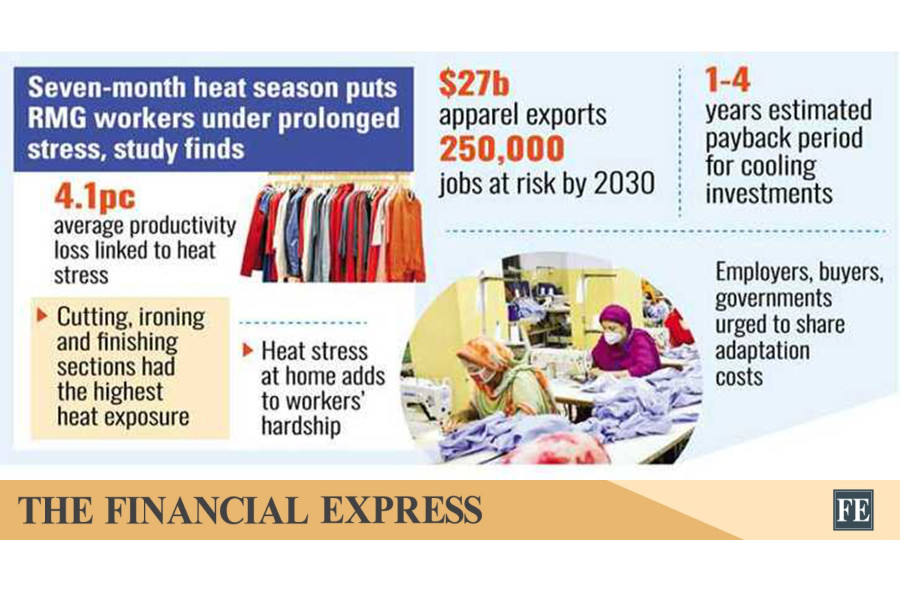
Workers in the ironing and finishing segments of Bangladesh’s readymade garment (RMG) sector endure extreme environmental hazards inside factories, spending over three-quarters of their working days under high or severe heat stress during an expanding seven-month heat season, a new study has found.

The report, released Monday by Cornell University’s Global Labor Institute, revealed that while the physical burden on these workers threatens human health and factory output, an industry-wide investment of US$239 million — equivalent to just 0.2 per cent of Bangladesh’s 2025 export revenues — could help reduce factory heat stress.
The investments could also generate financial returns for manufacturers by improving productivity, with the study finding that cooling measures could pay for themselves within one to four years.
Titled ‘Six Seasons, Four Summers: How to solve fashion’s high heat problem’, the report is the first to quantify both the costs of extreme heat and the financial returns from reducing it in the fashion industry, according to the authors. It examines how heat-adaptation measures can protect workers while improving productivity and employer earnings.
The findings show that Dhaka experienced a seven-month heat-stress season in 2025, which the authors describe as “the new norm”. Heat stress inside factories was consistently higher than outdoor levels, the report said.
Researchers from Cornell partnered with BRAC University, YGEN Engineering and the Bangladesh Centre for Worker Solidarity to conduct a year-long analysis of heat stress in garment factories and workers’ homes.
The study used electronic temperature and humidity sensors in eight factories and 37 workers’ homes, alongside engineering assessments, to measure heat exposure and estimate the costs and potential returns of reducing it.
The greatest exposure was recorded in cutting and ironing/finishing sections, where workers spent a substantial share of their working time in the hottest months in “caution”, “high” and “severe” heat-stress zones, according to the report.
Workers also frequently continued working despite dangerous heat conditions, the researchers found.
Across the eight factories studied, heat stress was associated with an average 4.1 per cent loss in working-time productivity.
Engineering assessments found that targeted measures, including roof insulation, improved ventilation and mechanical cooling systems, could substantially reduce heat exposure, delivering a return on investment by improving productivity and protecting workers’ health.
Under a more pessimistic “headwinds” scenario, the average payback period across the eight factories was 2.9 years, while under the worst-case scenario it was just over four years, according to the report.
The authors said the business case remained positive even under more conservative assumptions involving higher capital and energy costs and lower productivity gains.
The findings build on Cornell’s landmark ‘Higher Ground?’ study published in 2023 with Schroders, which found that extreme heat and flooding could put $65 billion in apparel exports at risk across Bangladesh, Cambodia, Pakistan and Vietnam by 2030 — equivalent to a 22 per cent loss in export earnings — while reducing potential job creation by nearly one million due to slower industry growth.
For Bangladesh, that study estimated that $27 billion in apparel exports and 250,000 potential jobs could be at risk by 2030.
But the impacts do not stop at the factory gate. The research found that workers are also experiencing rising heat stress at home, where increasingly hot nights limit recovery from long shifts spent working in high temperatures.
Hotter homes are also driving up electricity, medicine and other household costs, with surveys finding that workers reported borrowing money, pawning belongings or cutting spending to afford fans, electricity and healthcare during the hottest months.
The authors called for greater coordination among brands, manufacturers, governments and international institutions to address extreme heat in apparel workplaces and share the costs of adaptation.
“The problem is urgent and we already know what can be done to reduce heat stress,” said Jason Judd, executive director of Cornell University’s Global Labor Institute.
He said practical solutions were available to manufacturers and that addressing heat stress made sense from both business and worker health and safety perspectives.
“The challenge now is deciding how to share the costs fairly and scaling these solutions across the industry,” he said.
“This means acting together — employers, buyers, workers, government — through mandatory programmes such as the International Accord, which provide a framework for putting solutions into practice and spell out how responsibility is shared,” he added.
The paper noted that there was no single solution to heat stress and that measures would need to reflect the conditions and requirements of individual factories.
“There is no one-size-fits-all solution to heat stress. Every factory is different, so measures need to reflect the factory’s design and production processes,” said Tareq Ahmed Robin, managing director of YGEN Engineering.
“The important thing is to start now, with practical steps — insulation, improved airflow, active cooling for the hottest areas — and to build on these measures as heat stress rates go higher,” he said.
Kalpona Akter, executive director at Bangladesh Centre for Worker Solidarity, called for workload adjustment for workers when heat increases.
