

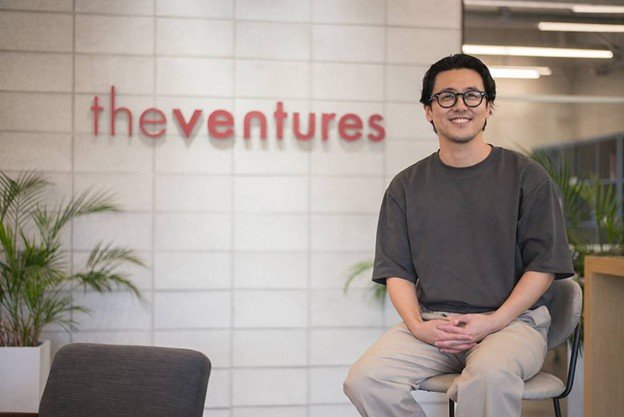
“TheVentures CEO Sean Kim: ‘Don’t Idealize Entrepreneurship—Try It.’”
Editions
TheVentures CEO Sean Kim: “Don’t Put Entrepreneurship on a Pedestal—Just Give It a Try”
- listen
- Font size down
- Font size up
Posted September. 23, 2026 11:28,
- listen
- Font size down
- Font size up
– Sean Kim says Korean founders need bigger ambitions, and TheVentures aims to support them as a founder-friendly bridge to global markets.
– The firm is using AI to speed up investment decisions while publicly sharing its investment interests to reduce friction for startups.
– Kim encourages more people to try entrepreneurship early, focus on rapid experiments, and see starting a business as a valuable learning experience.
“Korean founders are highly capable by global standards. But perhaps because they come from a culture that values humility, few talk openly about big ambitions. American founders, by contrast, often make seemingly outlandish claims about changing the world or building a company worth tens of trillions of won. That can put people off, but I have never seen a company grow bigger than its founder’s dreams. I believe a founder’s potential comes more from the scale of their ambition than from their capabilities.”
Sean Kim, CEO of TheVentures /
That was Sean Kim’s response when asked, from his perspective as an active investor, what mindset Korean startup founders should adopt.
Kim founded the secondhand marketplace Sellit in 2014, first connecting with TheVentures when the firm provided seed funding. Sellit was subsequently acquired by Kakao, giving him experience as an executive at a subsidiary of a major corporation. In 2018, Sellit merged with Quicket, and Kim went on to make his mark as chief product officer of Bunjang. In 2020, he joined TheVentures at the invitation of its then-CEO, Ho Chang-sung. He took the helm in 2021 and is now in his fifth year leading the firm.
Having achieved the kind of successful exit that many founders dream of, Kim now invests in startups and helps Korean companies expand globally.
Founded in 2014 under the motto “Founders Helping Founders,” TheVentures specializes in early-stage startups. It serves as both an accelerator, nurturing new businesses, and a venture capital firm, making direct investments and managing funds. With the second round of the government’s “Entrepreneurship for All” program encouraging people nationwide to start businesses, we visited Kim’s Seongsu office to hear his perspective.
Five Years at the Helm—and an AI Push Gaining Momentum
Kim’s first impression was closer to that of a charismatic business colleague than a stern investment firm chief. In an investment meeting, he would undoubtedly carry the authority of the final decision-maker. Throughout the interview, however, it felt more like speaking with an experienced fellow entrepreneur.
Our first question concerned the goals he had set when taking over as the firm’s second-generation leader—and how he assessed his progress today.
“When I became CEO, I set two main goals,” Kim said. “The first was to become a founder-friendly investment firm. TheVentures was already a gathering of former founders, and I felt Korea’s investment market lacked sufficient understanding of entrepreneurship. Launching our global consumer goods fund and eliminating complicated administrative procedures after the first meeting were also decisions intended to reduce the burden on founders.
“The second was to bridge the Korean and international startup ecosystems—to help Korean companies play a role overseas and create a foundation for us to invest in companies abroad.”
“These were more about setting a direction than hitting quantitative targets,” he continued. “But I think we have reached a point where, if you ask founders in Korea who are building for global customers where they would like to raise funding, TheVentures is among the first few names they mention.”
This year, the firm has been introducing Korean startups to international audiences through its English-language media channel, TheVentures Research. It also invests directly in overseas markets, including Southeast Asia, positioning itself as a bridge between Korea’s startup ecosystem and the rest of the world.
Although TheVentures is an investment firm, it makes decisions at startup speed. Behind that speed is Vicky, an AI platform developed last year.
“Our challenge is to invest in many companies and generate results,” Kim said. “To increase our investment volume, we couldn’t rely on the conventional process of multiple rounds of investment review. We approached the problem by using technology to make the entire investment process more efficient, which led us to AI.
“After Hwang ‘Jace’ Sung-hyun joined as tech lead last year, we began adopting AI in earnest. Today, AI alone determines whether we hold an initial meeting. We also use AI in investment evaluation and subsequent procedures, including drafting contracts and reports.”
Asked to explain how AI decides whether a startup gets a first meeting, Kim elaborated:
“Our internal data shows that Vicky’s judgments agree with those of human reviewers more than 90% of the time. Initial screening used to take around 30 days. Now, the first assessment is completed in under five minutes. We have also handed tasks such as portfolio reviews and growth reports over to AI.
“By the time a meeting is scheduled, we have already completed a basic assessment of the company. We therefore skip a separate pitch, spend about 20 minutes on the questions needed to make an investment decision, and then decide whether to invest. Some firms in the United States have shortened the time from first contact to an investment decision to under three hours. We have streamlined our own process to the point where, if you first contact us on Tuesday, we can give you an answer on Thursday.”
To an outside observer, that might seem unusually fast. From a founder’s perspective, Kim argues, it looks different.
“The number-one thing founders want to hear from an investor is, ‘We’ll invest.’ Number two is a quick no. Venture capital firms have little incentive to decide quickly, but founders have to keep worrying about the outcome until a decision is made. Moving quickly serves both founders and investors, and we are constantly thinking about how to make the process even simpler.”

An Open Call for Startups—and the Results of a Bolder Approach
One example of the firm’s investment philosophy is the open Request for Startups, or RFS, which it introduced last year. Under this approach, investors publicly announce their areas of interest and invite startups to apply.
Korean venture capital firms have traditionally kept their investment interests largely private, leaving founders to spend time searching for investors likely to recognize their value. We asked Kim what prompted the change.
“Introducing RFS was another step toward becoming a founder-friendly firm,” he said. “From the outside, you can’t tell which sectors an investor is interested in, so you have to contact everyone. That wastes a great deal of time. Investors, meanwhile, receive applications from companies in sectors they aren’t interested in, adding to their workload. RFS is already widely used overseas, and we made our interests public for the same reason.”
“The need to deploy more capital from our global consumer goods fund also played a role,” he added. “After we disclosed our interests, global consumer goods increased from less than 10% of our total investments to 30%. I think it is a very efficient way to align expectations between founders and VCs.”
FruitsFamily is one of TheVentures’ flagship portfolio companies /
We also asked Kim to introduce some of the firm’s best-known investments.
“HeyDealer is probably the most widely recognized company we invested in. We were its first and only seed investor, but unfortunately, we exited before it really took off. I wish we could have stayed with it longer.
“Shared mobility company Gbike is another investment. After the founder left and the CTO became CEO, we weren’t able to offer much help on the business side, but the company grew exceptionally well on its own. It reminded us to stay humble: investors and entrepreneurs see things differently.”
“FruitsFamily, the secondhand fashion platform, is another good example,” he continued. “As its sole investor, TheVentures has supported it since the pre-seed stage, and it now has more than three million monthly users. When we invest, we actually tend to pay particular attention to the founders’ stories. The company is growing with metrics reminiscent of Karrot. It has many users in their teens and twenties and is evolving into a community, so I believe it will deliver noteworthy results.”
Interestingly, both HeyDealer and FruitsFamily, two of the firm’s key portfolio companies, are resale platforms. That may be no coincidence, given Kim’s entrepreneurial background at Sellit and Bungaejangter.
So what does he look for in an investment?
“I like founders who dream big but focus on something small,” Kim said. “Even if the business looks small today, I look closely at how specific their focus is and whether they know their domain better than anyone else. Startups have limited time and resources, yet an enormous number of problems to solve. Even concentrating on one thing may barely be enough. I look for a sharply defined understanding of the problem and a clear focus on the market.”
“At the same time, our investment philosophy is, ‘We don’t know either,’” he said. “The attitude we are most wary of is, ‘We tried that, and it didn’t work.’ Out of 100 early-stage investments, the vast majority will fail, and only a handful will succeed. If an investment firm lets past failures dictate its decisions, it becomes increasingly conservative and loses touch with founders.
“Early-stage investing means recognizing even a small possibility and acting boldly, while accepting the risk of loss. Vicky is also designed to assess businesses much more optimistically than a human would.
“I always ask, ‘If everything works out exactly as you hope and imagine, how big could this company become?’ Solving the challenges immediately in front of you matters, but we are looking for people who can also picture what the business will look like if everything goes right.”
Bringing Entrepreneurship to Everyone
TheVentures has been actively involved as an operating partner for Entrepreneurship for All, which launched in March. It is also recruiting participants for the program’s second round.
As an accelerator and venture capital firm focused on aspiring founders and early-stage startups, its interest in the program is natural. The first edition attracted 63,000 applicants nationwide. TheVentures screened approximately 500 applicants and advanced 18 teams to the first round. Two teams were subsequently selected for the second round.
Selected startups were paired one-on-one with members of TheVentures’ evaluation team for mentoring.
“What matters is running as many experiments as possible within the time available to build a product that fits the market, then using the results to make better attempts,” Kim said. “We don’t know whether any particular business will succeed, so we have our own methodology for designing experiments and refining the business based on what they reveal.
“I also believe that starting a business is something you do when you want to, even when you know nothing and don’t feel ready. Once you start preparing to start a business, you can end up preparing forever. I hope the government continues programs in this spirit beyond the second edition, and that we build a culture where anyone can get started as soon as they decide to.”
“Korea has a particular tendency to treat entrepreneurship as either a sacred undertaking or a path of hardship,” he continued. “Startup support programs have also generally targeted businesses that have moved beyond an idea to something more concrete. So it is encouraging to see the government, rather than the private sector, create a foundation for supporting entrepreneurship at the idea stage.
“In the United States, many founders begin with an idea or a side project. I see this as a program that could create a new culture and understanding of entrepreneurship.”
“Anyone with a business idea can apply. Once you try, you will quickly get a sense of whether running a business suits you. Of course, there is no single type of person who is cut out for entrepreneurship. Some start because it looks exciting, others are brought in by a friend, and many begin as a side business.
“At the idea stage, it is normal for 90 out of 100 ventures not to work out. I hope people will see value in the attempt itself and apply.”
What Might TheVentures Look Like Five Years from Now?
Kim is now in his fifth year leading TheVentures. We asked what he would like the firm to look like in another five years, when he reaches his tenth year at the helm.
He highlighted two aspirations.
“I hope people will continue to say that we are a founder-friendly investment firm, and that if you want to work with Korean startups in the global market, you need to speak with TheVentures. We are already actively investing both in Korea and internationally, and I intend to make that vision a reality.”
“I don’t plan to run TheVentures forever,” he added. “Around my tenth year, I would like to hand it over to a founder from the next generation. I would love to see someone from one of our portfolio companies become the next CEO of TheVentures and then invest in the founders who come after them.
“Beyond that, I want to create an environment where Korean entrepreneurs speak up more actively. In Korea’s startup culture, we don’t often see founders publicly sharing their views or passing on their philosophies. I want to help build a culture where anyone can express an opinion without feeling diminished by failure. I intend to do the same myself.”
Finally, we asked what advice he would offer the next generation as both a former founder and an investment firm leader.
“Entrepreneurship isn’t right for everyone, but I think it is an experience worth trying at least once,” Kim said. “Starting a business teaches you who you are, and life doesn’t offer many opportunities to discover that.
“You see clearly how you make decisions in a crisis. You might discover that you care more about money than you thought, or that you are less mentally resilient than you imagined. That alone can make the experience worthwhile.
“Don’t put entrepreneurship on a pedestal. Get out there and give it a try.”
Most Viewed
- 루게릭 투병중 로또 3등 됐는데…찾으러 간 아들이 잃어버려
- [오늘의 운세/9월 23일]
- 박신혜♥최태준, 22일 둘째 득녀…“산모와 아이 모두 건강”
- 린, 심수봉 발언 논란 겪은 김다현 응원…“감성여왕 사랑해”
Headline News
EXO fan wins Asian Games gold for Hong Kong
Opinion
- EditorialWill Seoul give up leverage for nuclear freeze?
- Op-edHigh cost of obesity drugs widens health gap
