

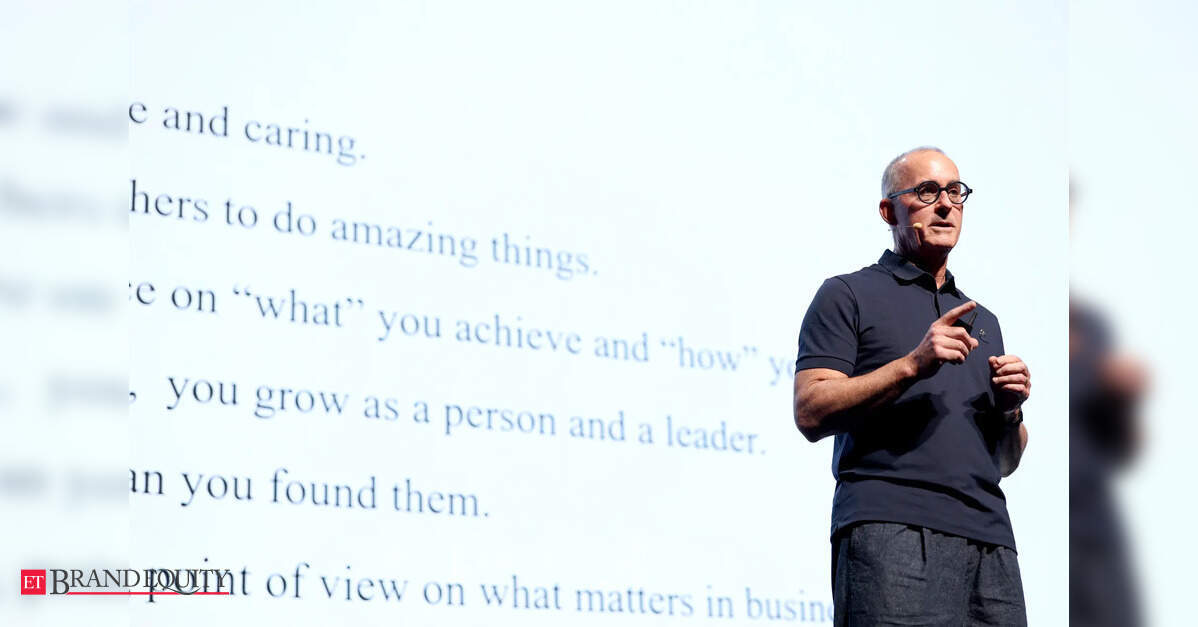
- Jim Stengel critiques modern brand strategies at Cannes Lions 2026.
- He emphasises grounding corporate purpose in business metrics.
- Stengel advocates for technology to streamline marketing processes.

Speaking at the Cannes Lions International Festival of Creativity 2026—where he was awarded the first-ever Lions Laureate Award for marketing— Jim Stengel, the former global Chief Marketing Officer of Procter & Gamble (P&G) delivered a critical assessment of how modern enterprises deploy brand strategies.In his address to the festival, Stengel coupled his critique of brand strategy with a definitive operational mandate for modern corporate design. Corporate marketing departments must aggressively deploy technology to eliminate non-value-added administrative workflows, reallocating human capital toward direct customer proximity and creative execution.The declaration that brand purpose has become a compromised asset carries significant weight given Stengel’s historical role. During his 25-year career at P&G, which he departed after executing a sweeping creative restructuring of the consumer giant’s global portfolios, Stengel championed the thesis that corporations focusing on a core mission beyond mere functional product benefits achieve superior financial returns.However, the proliferation of superficial corporate positioning has triggered a significant institutional backlash from quantitative market theorists and institutional investors alike.Stengel directly addressed this intellectual conflict, explicitly citing the criticisms levied by prominent market commentators and academics, including Byron Sharp and Mark Ritson.”When you hear Byron and Mark Ritson sh*****g all over purpose, it’s because I think they don’t understand the concept, and I think the word now carries too much baggage,” Stengel stated, acknowledging that the marketing industry has brought this skepticism upon itself. “People equate purpose often with social marketing and cause marketing—making the world better. Well, maybe it can lead to that, but purpose starts with the essence of your brand. What is the impact your brand is trying to make in the lives of the people it serves?”The core vulnerability of modern corporate purpose, Stengel argued, is its frequent failure to link directly with operational balance sheets. He delivered an explicit warning to corporate boards currently designing multi-year brand strategies: “When purpose is not grounded in business, it will not be sustained.”To salvage the strategic utility of the framework, Stengel suggested that corporations abandon the overused terminology of purpose entirely, replacing it with a disciplined operational question. How can an enterprise systematically expand its measurable impact on the lives of the consumers it seeks to serve and delight?To defend the commercial validity of value-led governance against quantitative critics, Stengel presented a retroactive analysis of the five most profound operational lessons that were presented at the CMO Accelerator program conducted during the Cannes Lions festival. The selected cases were framed not as exercises in corporate altruism, but as evidence-led models of structural transformation and commercial conversion.1. Brand-Driven Creative Leverage (Dove, 2014)Reviewing the operational execution behind the “Dove Sketches” campaign with former creative producer Veronica Beach, Stengel highlighted the commercial durability of a clear brand proposition across successive management changes.2. Structural Redefinition of Corporate Assets (Mattel, 2024)The address deconstructed the turnaround strategy presented to the Accelerator by the Chief Executive of Mattel in 2024. Facing structural stagnation within traditional manufacturing, the enterprise executed a fundamental shift in corporate mindset: redefining the firm from a legacy toy manufacturer into an intellectual property (IP) corporation managing global franchises. Driven by creative collaboration, this structural reallocation unleashed latent portfolio value, demonstrating that creative repositioning can fundamentally alter a company’s macroeconomic trajectory.3. Strategic Grounding of Creative Courage (The Fernando Machado Framework)Analysing the continuous contributions of Fernando Machado across roles at Burger King, Activision Blizzard, NotCo, and Chipotle, Stengel isolated the operational link between creative risk and commercial accountability. The lesson enforced within the Accelerator is that bold, culturally resonant marketing must remain continuously grounded in rigorous strategy and verifiable commercial results to preserve organisational alignment and agency efficacy.4. Product Transcendence and Customer Participation (REI, 2017)The analysis reviewed the structural risk assumed by outdoor retailer REI during its 2017 Black Friday “#OptOutside” initiative. By systematically closing all physical retail locations and halting online e-commerce operations on the primary shopping day of the consumer fiscal year, the firm established a cultural position that converted standard transactional customers into active participants in the brand’s core mission. The move successfully strengthened long-term brand equity and balance sheet resilience by establishing distinctiveness entirely independent of immediate product specifications.5. Institutional Provocation and Renegade Capital (Galloway)Stengel highlighted Professor Scott Galloway as the Accelerator’s most frequent early contributor for the initial five years. Galloway’s role was defined by data-rich, database-driven thinking designed to provoke institutional restlessness. The operational takeaway for corporate leadership is the necessity of systematically importing external, dissenting perspectives to challenge internal corporate consensus and reset operational priorities.The Restructuring of Marketing InfrastructureBeyond high-concept brand strategy, Stengel articulated a clear perspective on the internal architecture of modern marketing divisions. When asked what emerging professionals should prioritise or discard, he directed an aggressive focus toward structural rationalisation.”We’re in a world where I think we have great potential to eliminate a lot of non-value-added administrative process work,” Stengel stated. “So get that taken care of. We have technology that can help with that. Focus more of your time on the stuff that moves a brand and business and culture, and it starts with a customer.”This operational agility demands a parallel evolution in human capital development. Stengel characterised modern corporate career paths as “jungle gyms, not ladders,” asserting that standard vertical linear advancement is an outdated model for talent cultivation. He emphasised that lateral movements encompassing diverse geographies, brand categories and operational environments are frequently the most valuable vectors for developing executive capability.Reflecting on his own 25-year tenure at P&G, Stengel noted that his career was enabled by working across distinct European and North American operational theaters, while citing his lack of direct, on-the-ground operational deployment within Asian markets as a distinct professional regret.P&G and the Dan Wieden FrictionTo contextualise the leadership required to execute deep corporate transformations, Stengel disclosed previously unrecorded historical details surrounding P&G’s creative re-engineering. Entering Cannes in 2003 as a newly appointed global CMO, Stengel sought to systematically dismantle P&G’s rigid, formulaic advertising standards to reverse stagnating volume growth. The initiative ultimately culminated in the corporation securing its first Cannes Creative Marketer of the Year designation in 2008.However, the operational execution of this transition required overcoming deep structural friction, highlighted by Stengel’s accounts of his 2008 negotiations to recruit the independent agency Wieden+Kennedy. Upon initially being approached at the festival, the agency’s co-founder, Dan Wieden, delivered a definitive refusal.”I met Dan Wieden in Cannes that year,” Stengel disclosed. “I said, ‘would you ever consider working with Procter & Gamble?’ And he quickly said, ‘no.’ He said, ‘it wouldn’t work. It would be bad for the W+K culture.'”To bypass this impasse, Stengel executed a deliberate intervention, traveling directly to Wieden’s headquarters in Portland to challenge the agency’s assumptions regarding corporate scale.”I went and sat down with him in Portland, and I said, ‘this will not be easy, but if we can find a way to work together, you will make us better. And actually, I think we will make you better,'” Stengel stated. The subsequent partnership altered P&G’s global asset execution, proving that managing internal resistance requires establishing a rigorous, data-rich, and emotionally compelling “case for action” that clearly articulates the underlying “why” behind strategic change.The Institutional Synthesis: Consistency Over NoveltyAs the global marketing landscape recalibrates in 2026, the long-term resolution of the debate between value-driven purpose and quantitative execution appears to lie in institutional consistency over continuous creative novelty.Citing recent analysis of Coca-Cola’s long-term commercial performance and direct consultations with Tor Myhren, the Vice President of Marketing Communications at Apple, Stengel noted that the world’s most resilient enterprises succeed through methodical, multi-decade asset leverage.”They don’t get enough talk because they are consistent over time, they leverage their assets, and they’re creative and consistent,” Stengel, quoting a Mark Ritson observation of Coca-Cola’s consistent corporate strategy. “And just slowly and methodically, they build an amazing business, amazing brand…. Great luxury brands, great consumer brands, great technology brands are consistent over time. That’s hard. That takes leadership.”
