

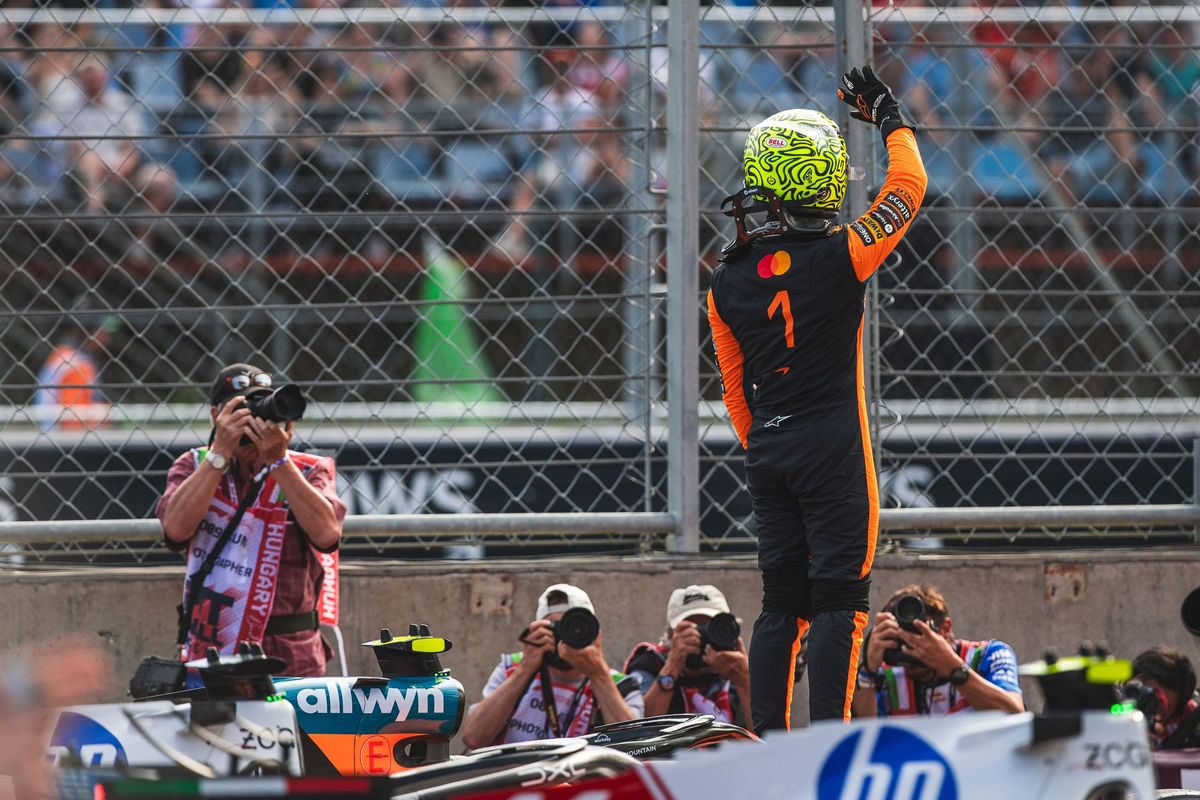
The long-term Formula 1 driver deals keep coming, as defending champion Lando Norris has extended his stay at McLaren until at least 2030.
That’s in line with the recent announcement that four-time F1 champion Max Verstappen will remain at Red Bull until the same year, while Charles Leclerc’s contract at Ferrari could run even longer than that.
Norris’s stock right now is arguably the highest it’s ever been; as defending champion, he has also won the two most recent races as McLaren’s 2026 development begins to bear fruit.
So was a berth anywhere else realistic? What does this say about the driver market? And what are the consequences of more and more longer-term deals being announced?
The F1 driver market is dead
It’s unfortunate how static the F1 driver market is at the sharp end.
This is not a point about Norris or McLaren specifically – this is a sage deal for both parties – but it feels like whatever incentive structure existed in the past for drivers to sign shorter-term or properly explore alternative options and try to manoeuvre themselves is totally, totally gone.
It may have been gone already for a decade or so, but it feels like something you could connect to the explosion in team valuations under Liberty Media. A driver salary cap to go with the cost cap was explored but never introduced and while that’s good from a labour point of view, it means truly generational wealth is available to all the top drivers rather than just outliers such as Michael Schumacher and Lewis Hamilton in the past.
These deals create security against the natural ebb and flow of a driver’s market value. And changing teams is hard, so is a great way of accidentally tanking that market value. It’s different in other sports – when you go from, say, Tottenham to Bayern in football, you don’t need to learn an all-new ball, you just need to adjust to actually winning games for a change.
And, yes, Hamilton-to-Ferrari was an exception but if he were 15 years younger, he’d obviously be on a Mercedes deal to 2035 right now.
No possible reason to look elsewhere
While Verstappen and Red Bull is the defining team/driver partnership of the 2020s, Norris and McLaren isn’t so far behind. Therefore, it’s logical for this alliance to keep a long timeline in place.
The choice of 2030 aligns well with F1’s rules cycles and also other deals, such as Verstappen’s recently announced Red Bull contract. There are similarities there in that Norris has had enormous success with McLaren and clearly feels very comfortable there, but the difference is that, right now, McLaren has less to prove to Norris than Red Bull has to Verstappen.
Therefore, there’s no possible reason for Norris to look elsewhere, while from McLaren’s perspective it is wise to lock down Norris and continues to hold flexibility on Oscar Piastri’s seat.
That said, Piastri’s contract still has plenty of time on it, so there’s not necessarily need for urgency in extending that, which gives McLaren the flexibility should it want to make a move for someone else down the line. But don’t underestimate how strong a two-driver line-up this is.
A big downside to these big contracts
For McLaren and Norris this is the best thing to do: given the opportunity (car) he is winning races and McLaren has the determination under Zak Brown’s leadership to get back to its heydays of being a consistent championship-winning team.
Also to add to that, in reality, where else is there to go that would give a winning car and a team relationship that Norris currently has?
Piastri has had his chance to show what he is worth and he is very good, so I wouldn’t be surprised to see him also continue with McLaren. Why not? He fits in well and, again, when he has the opportunity (car) he can win races.
However, these long-term contracts are closing the doors to potential up-and-coming drivers and with more or less no testing available to show a driver’s talent, how is anyone going to show their worth? Take Leonardo Fornaroli, McLaren reserve and the reigning Formula 2 champion, for example: what happens to him?
F1 keeps talking about finding true talent, it even talks about getting a female into F1, but can someone please explain to me how these scenarios can happen? Yes, we have testing of previous cars opportunities, but who really pays any attention to that?
Something needs to be done as the stepping stones to F1 through Formula 3 and F2 are just too expensive. It’s always been the same and as Alpine has proven with re-signing Franco Colapinto, money is much more important than talent.
Your move Piastri
Norris’s extension puts Piastri in an interesting spot.
I have zero doubt McLaren doesn’t mind which of its drivers is winning races or championships, but only one of them has been doing that recently.
So you can imagine how McLaren is starting to become Norris’s team. Not that it’s favouring him but it’s naturally going to start coalescing around the stronger driver, in terms of direction.
Therefore you could see why Piastri (and manager Mark Webber) might be considering whether his long-term future should be at McLaren, beyond his likely-end-of-2028 deal.
The problem is his stock’s taken a knock versus 12 months ago. Since then, he’s blown a decent title lead and has looked firmly second-best to Norris this year with too many weekends, by his own admission, spent too far off the pace.
So while it’s tempting to wonder whether Piastri could be a project leader for someone such as Audi or Aston Martin – and I think he has the raw ability to be – he’s got to first get himself out of this current hole or risk being an unattractive second-best to Norris.
The market is a very different beast these days
With what has all the makings of a great Shakespearean play, the House of McLaren, the House of Ferrari and the House of Red Bull are now locked in following Norris’s contract extension until 2030.
Where once F1’s driver market was anow stopped
Instead, loyalty, stability and family are the order of the day. Verstappen and Leclerc have now been joined by Norris in taking themselves off the market for a while; and expect Mercedes to shore up its own situation pretty soon.
Stability may be less exciting than the drama of a big silly-season switch but it’s the logical outcome in an era of F1 where the cost cap appears (thanks to legacy infrastructure reasons) to have helped edge the top four clear of the pack for now – so prime seats are increasingly rare.
The pool of favourable options is narrowed down even more once one team locks in one of their A* drivers, as that makes becoming their team-mate less exciting because it means going up against another big gun with the same equipment.
Better to be the big fish in your own still very big pond and make it the best one of there, than face the headaches that come from a topline driver rivalry.
Leclerc, Verstappen and Norris all settling down makes perfect sense.
Is it exciting for gossip? No. But the family dynasties are now in play to shape F1 until the end of this ruleset, and that in itself is going to throw up plenty of its own drama.
McLaren has earned Norris’s trust
Of all the top teams in recent years, McLaren has proven it is better at developing a car than the rest – so if you’re Norris, McLaren is the only option.
Sure, Mercedes has started this cycle with a better package, but that was inevitable as soon as it was confirmed McLaren would remain a Mercedes customer for this ruleset.
McLaren is fighting Mercedes with one arm tied behind its back given it gets data last-minute from weekend to weekend and doesn’t have access to the data Mercedes has had while building this power unit. McLaren has no right being as close as it is. The last two tracks may have flattered it but it’s clear McLaren is developing towards Mercedes again and is trending in the right direction.
The only real downside is that power unit deficit as a customer, but as the rules cycle wears on that will be less of an issue as the status quo sets in. And in those circumstances, in the last ruleset McLaren became F1’s top squad.
With Leclerc and Verstappen tied down at the other top teams, and Kimi Antonelli set to lead Mercedes for as long as he wants to be there, there’s no better option for Norris. And even if one of those other teams had an opening, McLaren has earned Norris’s trust. It wasted a bit of his early career with poor cars but is certainly making up for that now.
Going elsewhere is going to get harder
On one level I get this: stability, trust, faith, reward etc.
On the other, you could look at it as somewhat shut off and lacking ambition for fresher challenges that can come up. Even, perhaps, dare one say that Norris may have a bit of Stockholm Syndrome in F1.
He’s only ever known Zak Brown-era McLaren. Of course, it’s served him well with a title and 13 grand prix wins so far. But by 2030 he will have raced for the same team for 12 seasons and if he needs or wants a change how much of a shock to the system will that be for him? And would he be able to adapt?
You presume that for a driver of Norris’s class it would be straightforward. But the longer he stays with a single team the harder it will get as more Antonellis come on to the scene.
The bigger question also here I feel is how Norris can stay hungry, motivated and avoid future burnout.
Contesting 25 grands prix a year (as will surely soon become the norm) over a decade-long-plus stretch is a big ask for anyone. Mika Hakkinen had to stop after a similar period, and so did Fernando Alonso to an extent with his World Endurance Championship and Indycar ‘break’ – and in both of those cases that was with much fewer grands prix on the calendar.
Perhaps modern drivers are more conditioned for the constant grind and can soak it up better through more understanding of the mental stress these days, which is of course a good thing and one that Norris can keep on top of.
