

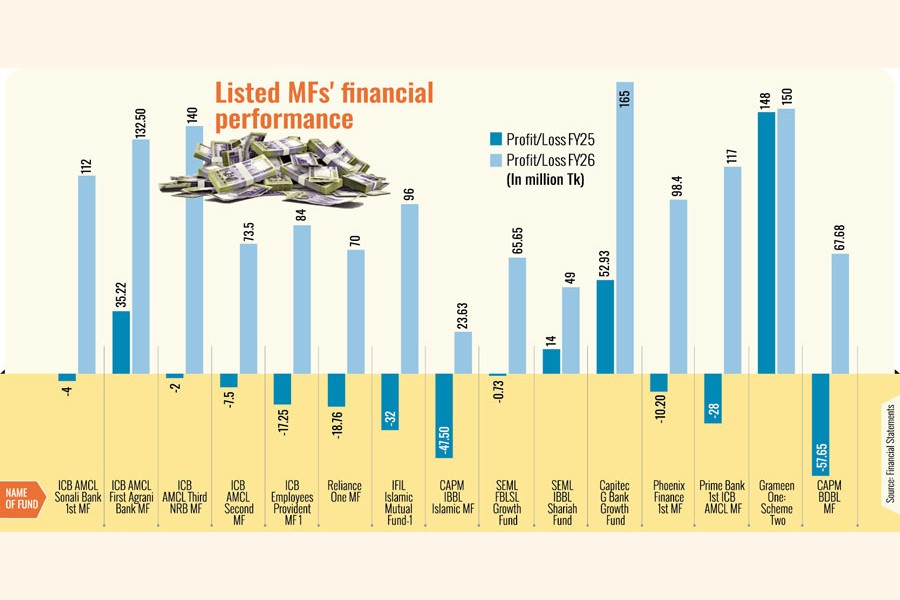
Most listed mutual funds posted hefty profits in FY26, riding a strong rebound in the stock market, but the earnings recovery brought little relief to unitholders as most of the funds skipped dividends due to accumulated losses from previous years.

The aggregate profit of 15 closed-end mutual funds, which published audited financial statements for FY26, climbed to Tk 1.44 billion from only Tk 24.4 million a year earlier. What is more significant is that 11 of the funds returned to profit in FY26 after incurring losses in the previous year.
Sixteen others of the 34 listed pooled funds are under regulatory scrutiny, while three funds follow the calendar year — January to December — for financial reporting.
The turnaround came as the stock market staged a strong recovery during the year, helped by gradually improving investor sentiment and growing optimism over sweeping regulatory reforms after years of poor market performance.
The benchmark index of the Dhaka Stock Exchange (DSE) surged 20 per cent year-on-year in FY26, while turnover jumped 55 per cent during the period, reflecting increased investor participation and a recovery in share prices.
The funds that published their results are managed by ICB Asset Management, Strategic Equity Management, CAPM Advisory, AIMS of Bangladesh and Capitec Asset Management.
Mutual funds, as major institutional investors, benefit when the stock market performs well because a rise in share prices boosts capital gains and the value of their investment portfolios.
Akramul Islam, head of research at Royal Capital, said mutual fund returns largely depend on stock market performance, as fund managers earn from capital gains through buying and selling shares, in addition to dividends, interest income and other investment returns.
“With share prices of many listed companies recovering during FY26, fund managers were able to book significant capital gains,” he said.
Funds with diversified portfolios and exposure to fundamentally-strong companies particularly benefited from the market rebound as the prices of their underlying securities appreciated during the year.
Fund managers generally prefer blue-chip and fundamentally strong stocks to minimise investment risks. Blue-chip stocks gained about 20 per cent during the year, contributing substantially to the bottom-line growth of many mutual funds, according to market analysts.
The improved market conditions also enabled fund managers to rebalance their portfolios and take advantage of changing valuations, helping them realise gains from investments accumulated at relatively low prices during the prolonged market downturn.
Under the securities rules, mutual funds are required to invest at least 60 per cent of their total assets in listed securities and bonds, with the remaining portion allowed to be channelled into money market instruments.
In practice, however, many fund managers injected as much as 80 per cent of their assets into the capital market.
Among the closed-end funds, Capitec Grameen Bank Growth Fund, managed by Capitec Asset Management, posted the highest profit of Tk 165 million in FY26.
Grameen One: Scheme Two, managed by AIMS of Bangladesh, followed with a profit of Tk 150 million, while ICB AMCL Third NRB Mutual Fund reported a profit of Tk 140 million.
Most funds skip dividends despite hefty profits
Despite the sharp improvement in profitability, most of the funds have not declared dividends for FY26.
Of the 15 funds that published audited financial results, only four announced cash dividends ranging from 4 per cent to 10 per cent.
Reliance One, the first scheme of Reliance Insurance Mutual Fund, declared the highest dividend of 10 per cent cash. ICB AMCL First Agrani Bank Mutual Fund declared a 4 per cent dividend, while Capitec Grameen Bank Growth Fund and Grameen One: Scheme Two announced 9 per cent cash dividends each.
Except for ICB AMCL First Agrani Bank Mutual Fund, other closed-end funds managed by ICB Asset Management skipped dividend payments for FY26.
That is because the funds are still carrying substantial accumulated losses from previous years, said Investment Corporation of Bangladesh (ICB) Chairman Abu Ahmed.
The funds are required to maintain provisions against previous unrealised losses before considering dividend payments to unitholders.
The prolonged market downturn had caused significant erosion in the value of many portfolios, leaving the funds with negative retained earnings.
“As the funds had negative retained earnings due to previous losses, they were not in a position to pay dividends even after adjusting for this year’s improved earnings,” Mr Ahmed said.
He said the funds were launched when the stock market was at a very high level, and the subsequent sharp fall in share prices substantially reduced the value of their investments.
Although the market has recovered over the past year, the funds have not yet fully recovered their previous losses, he added.
Among the 34 closed-end mutual funds, 30 are trading at discounts. Market capitalisation of all these funds stood at Tk 30.7 billion, while the Assets under Management (AUM) stood at Tk 44.5 billion as of Sunday.
