

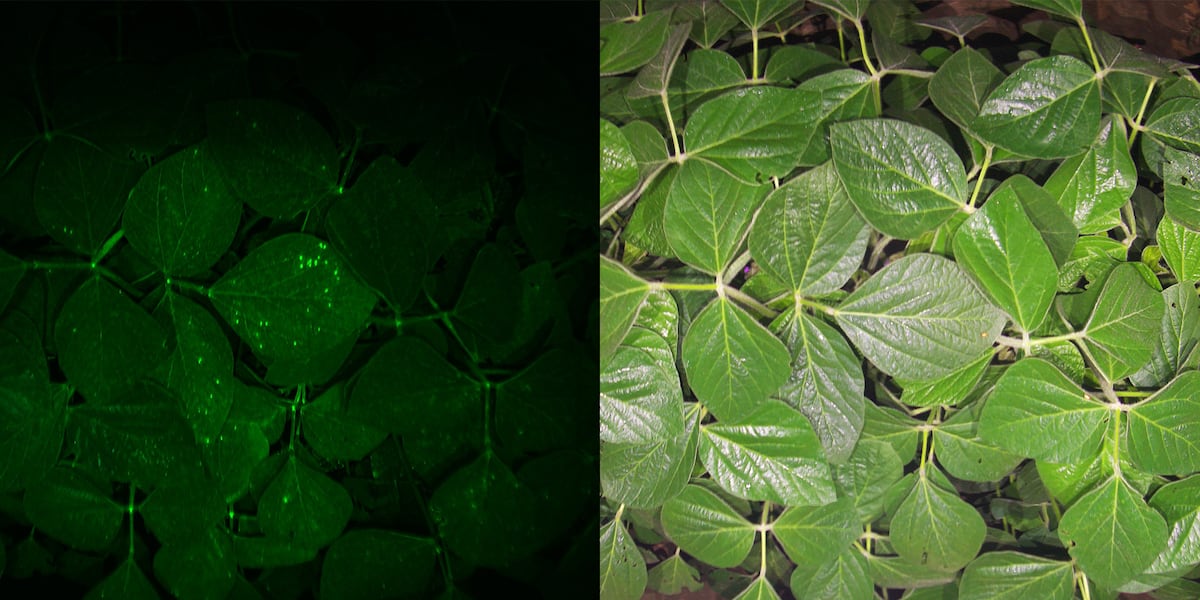
Neb. (KSNB) – A company called InnerPlant is using artificial intelligence to help farmers detect crop diseases before they become visible to the naked eye
The product, called CropVoice, was originally developed for soybeans and is now being adapted for corn.
Some corn plants are given a fluorescent dye. If disease is present, it shows up under a specialized light. That information is then fed into an AI model, which can predict where the disease might spread within the crop.
Gary Schaefer, with InnerPlant, said waiting to see fungal disease with the naked eye can be too late.
“In some cases, they would wait to see disease, which we know if we’re seeing disease, it’s too late,” Schaefer said. “With CropVoice, farmers are able to know within hours of infection when plants are infected so that they can take the right action to know what fields are infected, what disease is infecting these plants, where they need to treat, and what products they need to use for the specific diseases that are infecting the plants.”
Hamilton County farmer Brandon Hunnicutt said a tool like CropVoice could change how he runs his operation.
“Being able to really detect when that’s happening will be a game changer, because if I can get that fungicide treatment on one week earlier, ten days earlier, that could be the difference of a large number of bushels,” Hunnicutt said.
Hunnicutt said early detection can also preserve the effectiveness of his fungicide.
“If I keep spraying a fungicide without the disease present, at some point that fungicide will become ineffective, and that’s not what I want,” Hunnicutt said. “I want to be able to protect that crop, not just this year, but in years to come.”
Schaefer said the artificial intelligence component of the product helps process large amounts of data.
“We process a lot of data. And the ability to process this data is certainly helped with AI,” Schaefer said. “How we also use AI is to train models so that when we begin to see this fluorescence, we understand the patterns, we understand the ability for this to spread.”
Hunnicutt said the technology could also help farmers make more financially sound decisions with their fungicide budgets.
“I have a disease present, but is that in a one-acre area? Is that in a 160-acre area? What does that actual presence look like?” Hunnicutt said. “If it’s just one acre, but I treat the whole field, that’s money thrown away. If I don’t see it in one acre and the other 159 have it and I don’t treat it, now I’ve got a problem.”
The soybean version of the technology is already available to farmers. The corn version is expected to be released in 2027.
Click hereto subscribe to our KSNB Local4 daily digest and breaking news alerts delivered straight to your email inbox.
Copyright 2026 KSNB. All rights reserved.
