

The emergence of spatial transcriptomics has fundamentally reshaped the understanding of gene expression within intact tissues by enabling molecular profiles to be localized to precise cellular and anatomical contexts1. More recently, three-dimensional spatial transcriptomics (3D-ST) technologies have extended this paradigm beyond isolated tissue sections, allowing cellular organization to be reconstructed across entire tissue volumes2,3,4. This technological shift opens up new opportunities to investigate spatial gradients, long-range cellular interactions and disease-associated architectures5 that are inherently 3D, particularly in complex organs such as the brain6.
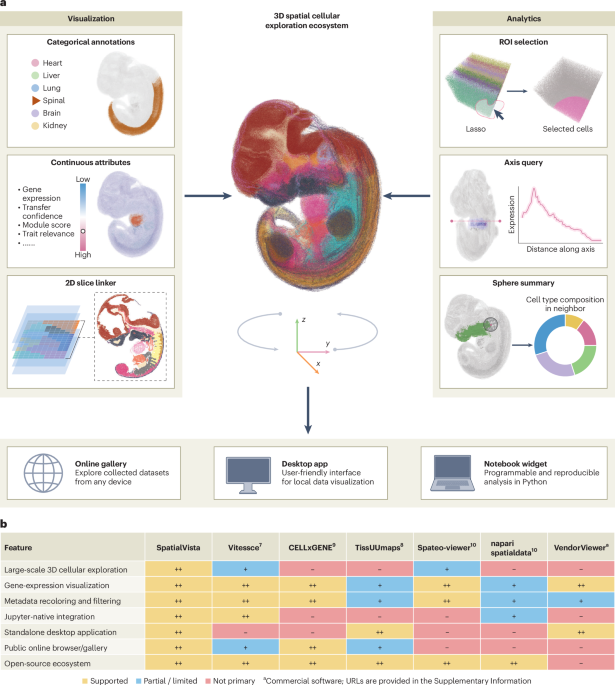
To address these limitations, we developed SpatialVista (https://yanglab.westlake.edu.cn/spatialvista), a unified visualization ecosystem designed for the integrated exploration of 3D-ST data throughout the entire analytical workflow. SpatialVista provides a shared set of high-performance visualization capabilities accessible through complementary interfaces, enabling consistent exploration of 3D-ST data across every stage of the analytical pipeline (Fig. 1a).
This is a preview of subscription content, access
Access options
- Purchase on SpringerLink
- Instant access to the full article PDF.
Prices may be subject to local taxes which are calculated during checkout
Subjects
Code availability
The SpatialVista online browser, desktop application and documentation are freely available at https://yanglab.westlake.edu.cn/spatialvista. The Jupyter/Python widget andl-vista-py under a BSD 3-Clause license
References
-
Moses, L. & Pachter, L. Nat. Methods19, 534–546 (2022).
-
Schott, M. et al. Cell187, 3953–3972.e26 (2024).
-
Sui, X. et al. Nat. Methods22, 2574–2584 (2025).
-
Kern, C. et al. Preprint at bioRxivhttps://doi.org/10.1101/2025.11.02.686137 (2025).
-
Song, L., Chen, W., Hou, J., Guo, M. & Yang, J. Nature641, 932–941 (2025).
-
Zhang, M. et al. Nature624, 343–354 (2023).
-
Keller, M. S. et al. Nat. Methods22, 63–67 (2025).
-
Solorzano, L., Partel, G. & Wählby, C. Bioinformatics36, 4363–4365 (2020).
-
CZI Cell Science Program. Nucleic Acids Res.53, D886–D900 (2025).
-
Qiu, X. et al. Cell187, 7351–7373.e61 (2024).
-
Sofroniew, N. et al. Zenodohttps://doi.org/10.5281/zenodo.20709435 (2026).
-
Wolf, F. A., Angerer, P. & Theis, F. J. Genome Biol.19, 15 (2018).
Acknowledgements
We thank Y. Wang and D. Yi for helpful discussions and the Westlake University High-Performance Computing Center for their assistance in computing. This work was supported by the National Natural Science Foundation of China (32595482, U23A20165), the National Key R&D Program of China (2024YFC3405800, 2024YFC3405802), the “Pioneer” and “Leading Goose” R&D Programs of Zhejiang (2024SSYS0032) and the New Cornerstone Science Foundation.
Authors and Affiliations
Ethics declarations
Competing interests
The authors declare no competing interests.
Peer review
Peer review information
Nature Genetics thanks the anonymous reviewers for their contribution to the peer review of this work.
Supplementary information
Supplementary Notes 1–6, Supplementary Figures 1–4, Supplementary Tables 1 and 2 and Supplementary References
Rights and permissions
About this article
Cite this article
Wei, W., Li, L., Song, L. et al. SpatialVista as a unified ecosystem for high-performance visualization and exploration of 3D spatial transcriptomics data.
Nat Genet (2026). https://doi.org/10.1038/s41588-026-02696-7
-
Version of record:14 August 2026
-
DOI
:https://doi.org/10.1038/s41588-026-02696-7
