

Abstract
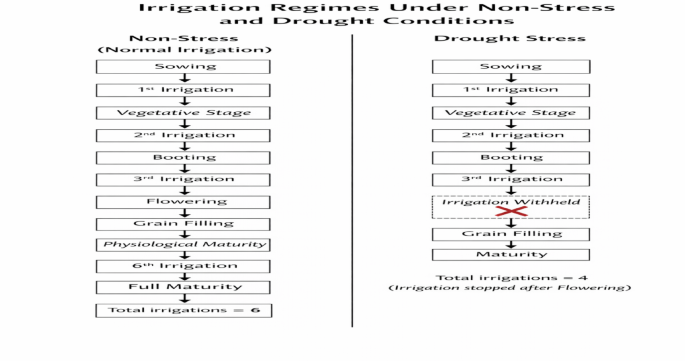
Developing high-yielding and water-stress-tolerant bread wheat cultivars with high water productivity is vital for sustainable wheat cultivation under the limited water resources in Egypt. In this study, bread wheat mutant lines from the M3, M4, and M5 generations and their mother cultivars were evaluated under both well-watered and limited-irrigation conditions over three growing seasons (2022–2024). Eight agronomic traits and water productivity were estimated to detect high-yielding, water stress-tolerant wheat lines with improved water productivity. Significant differences (p ≤ 0.05) were observed among the mutant lines for the studied traits under both conditions. Twelve selected mutant lines surpassed their mother cultivars. Mutant line G5 exhibited the shortest plant height with high potential yield, representing a dwarf phenotype. Mutant lines G10, G1, G2 and G4 exhibited the highest actual genetic gain relative to the highest-yielding mother cultivar. High broad-sense heritability coupled with moderate to high genetic advance for the studied traits indicated the predominance of additive gene action and confirmed the effectiveness of phenotypic selection. Drought tolerance indices selected the same promising lines under limited-irrigation conditions. GGE biplot analysis revealed that mutant lines G2, G3, G4, G5 and G6 were superior high-yielding lines, whereas G4, G7, G10 and G11 exhibited greater stability across irrigation regimes. Selected mutant lines exhibited improved water productivity compared with their mother cultivar under both conditions. Selected putative mutant lines will be advanced to multi-environment trials to further evaluate genotype x environment interactions and genetic stability. These mutant lines could serve as valuable genetic resources for bread wheat breeding programs aimed at enhancing grain yield under water-limited conditions.
Subjects
- Genetics
- Physiology
- Plant sciences
Funding
Open access funding provided by The Science, Technology & Innovation Funding Authority (STDF) in cooperation with The Egyptian Knowledge Bank (EKB). This work was supported by Academy of Scientific Research and Technology (ASRT), Egypt.
Authors and Affiliations
Ethics declarations
Competing interests
The authors declare no competing interests.
Additional information
Publisher’s note
Springer Nature remains neutral with regard to jurisdictional claims in published maps and institutional affiliations.
Rights and permissions
Open Access This article is licensed under a Creative Commons Attribution 4.0 International License, which permits use, sharing, adaptation, distribution and reproduction in any medium or format, as long as you give appropriate credit to the original author(s) and the source, provide a link to the Creative Commons licence, and indicate if changes were made. The images or other third party material in this article are included in the article’s Creative Commons licence, unless indicated otherwise in a credit line to the material. If material is not included in the article’s Creative Commons licence and your intended use is not permitted by statutory regulation or exceeds the permitted use, you will need to obtain permission directly from the copyright holder. To view a copy of this licence, visit http://creativecommons.org/licenses/by/4.0/.
About this article
Cite this article
Saber, A.A. Phenotypic selection of high-yielding, water-productive wheat (Triticum aestivum L.) putative mutants under well-watered and limited-irrigation conditions.
Sci Rep (2026). https://doi.org/10.1038/s41598-026-65822-9
-
DOI
:https://doi.org/10.1038/s41598-026-65822-9
