

Add to Google Preferred Sources
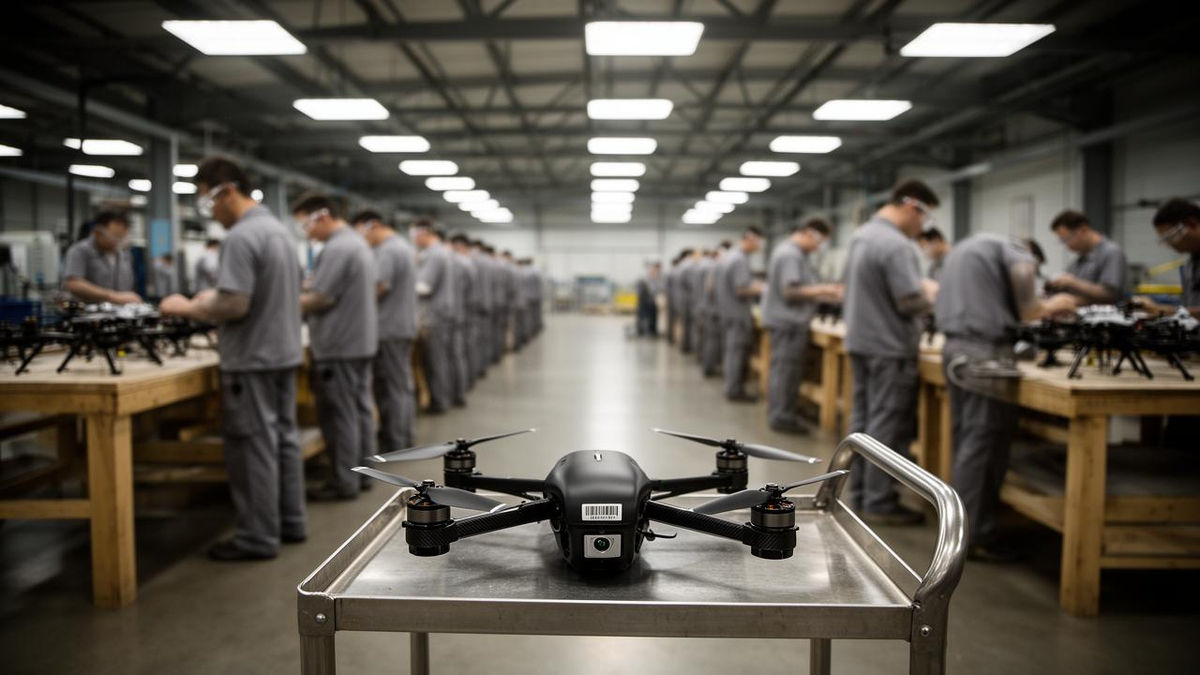
A tour of Neros’ 250,000-square-foot Los Angeles factory reveals a defense startup betting that manufacturing scale — not demo videos — is the real moat. CEO Soren Monroe-Anderson, speaking on the Sourcery podcast, walks through a facility sized for one million drones per year, currently producing over 250 drones a day on a deliberately manual assembly line. His contrarian logic: the drones were not designed for automation, and until a ground-up product redesign happens, manual stations with software tracking are more efficient than automating the wrong design. The factory is a statement against the industry’s prevailing trends — no battlefield 3D printing, no wind tunnels for quadcopters, and 100% flight testing of every unit until data proves sample testing is sufficient. The episode’s sharpest moment comes when Monroe-Anderson declares that the majority of defense-tech products from startups are “not very effective and maybe even completely useless.” The tour functions as evidence for that indictment: Neros is doing the unglamorous work of serial-number tracking, desert testing to failure, and raw material manufacturing — while competitors, he suggests, are selling narratives. With a recent $250 million funding round valuing Neros at $2.5 billion and a five-year Army contract worth up to $500 million, the company now faces the arithmetic of scaling from 250 drones per day to roughly 2,700 to hit the million unit target — a gap that depends on a product redesign and in-house component manufacturing that are only just beginning.
Key Elements

The American flag inside Millennium 1 is 30 feet by 60 feet — “as far as I know, the largest in the South Bay,” says Soren Monroe-Anderson, CEO of defense startup Neros, as he walks a podcast host through his company’s new factory. Employees navigate the quarter-million-square-foot floor on scooters and skateboards. Behind blackout curtains, teased as the most secretive part of the facility, sits a powerlifting gym. The building is deliberately oversized, with acres of empty space reserved for something that does not yet exist: in-house component manufacturing lines that will feed the assembly operation now producing a little over 250 drones a day.
Speaking on the tech podcast Sourcery, Monroe-Anderson makes clear that every visible choice inside this Los Angeles South Bay facility — from the carbon-plate airframes to the manual assembly stations to the absence of a wind tunnel — is in service of a single argument: in defense technology, manufacturing is the product, and most startups are not actually making anything that works.
“A lot of defense tech — maybe the majority of defense tech products that are being put out right now by startups — are not very effective… maybe even completely useless,” he says toward the end of the tour.
The host offers a one-word translation: “Fake.”
“They’re fake,” Soren agrees.
From 250 to a million: the arithmetic of the manual line
The core tension inside Millennium 1 is immediately visible. The facility is sized for one million drones per year — a run rate of roughly 2,700 units per day. Current production sits at “a little over 250 drones a day,” a figure that is meaningful but represents less than a tenth of the building’s designed capacity. Bridging that gap is the central manufacturing challenge Neros faces, and the factory tour is essentially a walk-through of the company’s answer: a deliberately manual present, an instrumented data pipeline, and a planned automated future that requires starting over from the product itself.
The assembly line is laid out as two parallel rows — drone assembly on the left, ground-station assembly on the right. Every station is manual. Operators work with preset-torque drivers and bins pre-loaded with parts fed from the back. A tablet at each station tracks serial numbers and cycle times, feeding a manufacturing database that identifies bottlenecks. It is a system that looks like legacy manufacturing but thinks like a software company.
Monroe-Anderson’s explanation for the manual choice is pragmatic to the point of being contrarian. “To get to an automated line, it takes a pretty significant redesign of the product itself,” he explains. The current Bandit Interceptor drone was simply not designed for robotic assembly. Automating the existing design would be a mistake — locking in a product that is still iterating rapidly. “For the rate at which we are iterating, it actually makes a ton of sense to have manually operated stations.”
The implication is that the product redesign needed for automation is a known, scheduled step — not a hope. Until then, software and instrumentation substitute for robotics. The data pipeline is already built, tracking every station’s cycle time and every component’s serial number. When the redesign lands, the data infrastructure will be ready. The empty floor space will be waiting.
This approach stands in direct opposition to the idea of distributed, on-demand manufacturing closer to the battlefield. Asked about 3D printing drones in the field — a question Monroe-Anderson attributes to a friend of the host — he delivers one of the episode’s clearest arguments. “3D printing is generally good for making a few of a thing. We are mostly focused on making a lot of one thing.” The distinction is fundamental: 3D printing works for prototyping or customizing airframes and payload adapters, but it cannot produce circuit boards, motors, or radios. The components that truly constrain supply have to come from a factory.
“Generally factories are really efficient when they are large and centralized,” he adds. “You’re not going to be 3D printing your circuit boards, your motors, your radios, any of that stuff out on the battlefield. So it does not solve the supply chain problem in the ways that are claimed in some of the posts today.”
The same single-site logic explains why Millennium 1 was built with so much empty space. Neros is “starting to do this year” in-house component manufacturing — bringing production of the parts that feed the assembly lines under one roof rather than managing a distributed supply chain. The stated end state is one building, no multiple sites, no second move, and the million-drone annual target.
A factory sized to never move again
The tour is as much about real estate strategy as it is about drones. Neros’ previous facility crammed 100 people into 15,000 square feet; the team was, in Monroe-Anderson’s words, “fighting to even get drones out the door.” Millennium 1 is nearly 17 times larger, and the key design constraint was simple: it had to be big enough that the company never has to relocate again.
| Dimension | Previous facility | Millennium 1 |
|---|---|---|
| Footprint | 15,000 sq ft | 250,000 sq ft |
| Headcount | 100 people | Not disclosed; 10-person flight-test team alone |
| Output posture | “Fighting to get drones out the door” | 250+ drones/day; sized for 1M/year |
| New-product line | No room | Dedicated NPI line larger than entire old production line |
| Strategy | Single cramped site | Single site with room for vertical integration |
Asked when he expects to outgrow this building, Monroe-Anderson’s answer is telling: “We don’t know, which is a good thing.” The uncertainty is intentional. The point of the exercise was to remove facility constraints from the list of problems Neros has to solve, so that the team can focus on the product and the process.
The layout reinforces this. Engineering desks sit directly next to the production line, with mechanical engineering, manufacturing engineering, and supply chain teams interspersed. The physical arrangement is a cultural statement: design work is not “thrown over the fence” into production. Everyone sees the consequences of their decisions in real time.
A dedicated new product introduction line — already larger than the company’s entire previous production operation — is currently developing the manufacturing process for the Archer AI drone, a product the host notes has “never been seen before.” Monroe-Anderson expects the Archer AI to move from the NPI line into main production later this year.
The tour’s lighter details still carry strategic signal. The 30-by-60-foot flag is performance at scale — a statement of ambition rendered in fabric. The scooters and skateboards are practical in a building this size but also signal a culture that treats the factory floor as a place where movement and speed matter. And the powerlifting gym, hidden behind blackout curtains and promised as the facility’s most secretive area, turns out to be used by only three to five employees on weekday mornings. “There’s a bike,” Monroe-Anderson concedes. The gag works because it undercuts the defense-industry gravitas while still making the point: this is a company that builds things, and the people who build things here also lift heavy objects for fun.
There is also a puzzle left for the viewer. Monroe-Anderson refuses to explain the company name, offering only: “Hold a mirror up to the logo.” The hint is a branding curiosity with an easy solution — Soren spelled backward is Neros — but the refusal to decode it is itself a small statement about what the company wants attention on: the product, the process, the facility. Not the myth.
Bandit Interceptor: the 300 km/h prototype chasing 400
The product centerpiece of the tour is the Bandit Interceptor, a counter-drone designed to kill incoming one-way attack drones. The flight-test area holds a V1 prototype that has been flying in desert development testing, alongside the Archer AI drone, which Monroe-Anderson says has been “getting beat to hell” in the same desert environment.
The newest Bandit prototype is the striking object on display: “still a pretty rough prototype, honestly,” but “a lot more sleek” and roughly 40 km/h faster than the previous version, putting it at about 300 km/h after “a couple months of development.” The speed target is mission-driven, not arbitrary. Three hundred kilometers per hour is “a pretty good spot for taking out typical Shahed drones,” the Iranian-designed one-way attack drones that Russia has used extensively in Ukraine. But jet-powered Shahed variants require “closer to 400 km/h” — what Monroe-Anderson calls the “ideal end state.”
The levers for closing the remaining 100 km/h gap are conventional but concrete: bigger motors, bigger battery, and continued aerodynamic refinement. The new airframe gained speed primarily from the latter — “a lot of the last one, still a lot of places we can improve” — which suggests the company sees aerodynamic optimization as a meaningful, incremental lever rather than a solved problem.
The materials discussion draws a direct, unsolicited contrast with a competitor the host had previously visited. At another defense startup’s R&D facility, cast metal drone bodies were presented as a feature — heavier, but usable as heat sinks. Neros takes a fundamentally different approach. Airframes are mostly carbon plates, chosen for the simple reason that “carbon is really light and really strong.” A flat aluminum bottom plate doubles as the heat sink, contacting the motherboard and radios through thermal interface material when the drone is closed out.
Monroe-Anderson frames the choice in cost terms: flat carbon plates and aluminum sheets are 2D-cut parts — cheap to manufacture at scale. Cast metal bodies require casting or CNC machining, adding cost per unit. “Carbon is really light and really strong, but it doesn’t have some of the advantages of what they were doing with those metal bodies — you get to use it as a heat sink.” The aluminum plate is a compromise that captures the thermal benefit while keeping the part simple and cheap to produce.
A detail that would surprise anyone familiar with aerospace manufacturing: Neros does not have a wind tunnel. For a company building interceptors designed to fly at 300 to 400 km/h, this might seem like an omission. Monroe-Anderson’s explanation is grounded in the physics of quadcopters versus fixed-wing aircraft.
“For our types of drones, these quadcopters are much less affected by wind than a fixed-wing drone,” he says. “We do a ton of testing in very windy conditions, but we’ve never needed to specifically put something in a wind tunnel.” Real-world testing substitutes for controlled-environment testing, and the company does “a ton of it” — the ten-person flight-test team deploys daily as two crews in two separate desert locations, two hours from the factory, deliberately trying to break prototypes.
Fixed-wing drones are a possible future, however. “A lot of the same stuff that’s been figured out in FPV — we can make lower-cost systems that are really effective. That applies in fixed-wing, too. And that is what Neuros wants to build, so at some point.”
The testing philosophy: flight-test everything until the data says stop
Perhaps the most operationally distinctive choice inside Millennium 1 is the company’s testing regime. Every single drone Neros produces — 250-plus units per day — is still 100% flight-tested by a human pilot before shipping. At this output rate, that represents a significant allocation of labor and time.
The process itself is three-layered. Development testing happens in the desert, where the ten-person flight-test team works as two daily crews in two different locations, with a mandate to push prototypes to failure. “Really we’re just trying to push everything to its limit and see where it breaks,” Monroe-Anderson explains.
Production testing starts with an automated pre-screen station that checks units for issues that previously would only have been caught in flight. Then a manual pilot mounts a mass-simulation payload — approximating the weight of a real warhead — and “basically just tries to stress the drone as much as they can in a relatively short flight,” whipping the aircraft through aggressive maneuvers. It is a deliberately brutal final exam.
| Test stage | What it does | Status as of Aug 2026 |
|---|---|---|
| Desert development testing | Two daily crews, two sites, two hours away; pushes prototypes to failure | Ongoing |
| Automated test station | Pre-screens production units before flight test | In production |
| End-of-line flight test | Manual pilot, mass-simulation payload, full-stress short flight | 100% of all units |
| Sample testing | Replace 100% flight test once data justifies it | “Still a little ways away” |
The purpose of this intensity is explicitly to end it. Neros is collecting data from both the automated station and the manual flight test to reach a point where it can transition to sample testing — flight-testing a statistically significant subset rather than every unit. The data accumulation is the product; the manual whipping is temporary. Monroe-Anderson says the company expects to stop flight-testing every drone and shift to sample testing once the automated test station data proves sufficient to catch defects reliably, though “that is still a little ways away.”
Monroe-Anderson’s indictment of the defense-tech startup field
The closing exchange of the tour retroactively frames everything shown earlier. The host asks for Monroe-Anderson’s hottest take, and the answer is immediate, unhedged, and devastating to the sector.
“Maybe the majority of defense tech products that are being put out right now by startups are not very effective and maybe even completely useless.”
The host translates: “They’re fake.” Monroe-Anderson agrees.
The line lands with force in context because the preceding 20 minutes have shown a company doing the unglamorous work that makes the indictment credible. Desert testing to failure. Serial-number tracking on a manual line. 100% flight testing of every unit. A factory sized for a million drones but running at a fraction of that while the product redesign and component infrastructure catch up. This is not a company claiming it has solved defense technology. It is a company arguing that the work itself — the manufacturing, the testing, the supply chain — is the proof, and most competitors are not doing that work.
The indictment is also a business thesis. If the field is full of products that do not work, then the company that can ship thousands of proven, tested, serialized units has a structural advantage that is difficult for latecomers to replicate. Scale becomes the moat — not the demo, not the white paper, not the policy brief.
The company recently raised $250 million at a $2.5 billion valuation, led by Sequoia Capital and the American Strategic Technology Fund, with participation from Peter Thiel Capital. It holds a five-year Army contract worth up to $500 million for the Archer drone and related systems. The resources are in place. The question is whether Neros can close the distance between 250 drones per day and the million-unit ambition before the “fake products” Monroe-Anderson dismisses have time to become real.
That funding round is a rapid re-rating: Neros’ Series B in November 2025 valued the company at roughly $794 million, meaning the new round values it at nearly triple that within nine months.
| Funding Round | Date | Post-Money Valuation |
|---|---|---|
| Series B | Nov 2025 | ~$794 million |
| Series C | Aug 2026 | $2.5 billion |
The urgency behind that re-rating traces back to defense policy. In a December 2025 directive, Defense Secretary Pete Hegseth’s Drone Dominance Program called for the U.S. military to field more than 200,000 low-cost drones by 2027, with an early target of roughly 30,000 units delivered by mid-2026. That is the policy backdrop against which Neros’ own million-unit annual target — and its bet that manufacturing scale, not flashy demos, is what wins contracts — is being tested.
Four milestones will determine the answer: whether the Archer AI drone reaches main-line production by the end of 2026 as planned; whether the 400 km/h Bandit Interceptor materializes, which would be a headline number in counter-drone capability; whether in-house component manufacturing lines actually come online inside Millennium 1 within the year; and whether Neros’ own shipped volumes make the “fake products” claim a self-fulfilling prophecy or a premature boast. The building is big enough for a million drones a year. The flag is big enough for the South Bay. Now the company has to fill the space in between.
Full content available at:Inside America’s Million-Drone Factory
- Nico Says Robotics Application Companies Will Be the New SaaS — and Four Research Labs Are Building the Tech to Prove It
- As Tariff Edge Fades and Hidden Supply Chain Costs Surface, Vietnam Factory Orders Are Flowing Back to China
- Trump Blasts Congress for Trying to “Put AI Industry Out of Business” with Regulatory Push, as NIST Releases Draft Guidelines
- China A-Shares Plunge at Open, Zhongji Innolight Tumbles 13% Leading CPO Rout
- Neros Valuation Tops $2.5 Billion, Aims for 1 Million Attack Drones Annually by 2028
Once added, BigGo Finance appears first in Google Search Top Stories, so you get the broadest, most up-to-the-minute, and most comprehensive global financial news first.
