

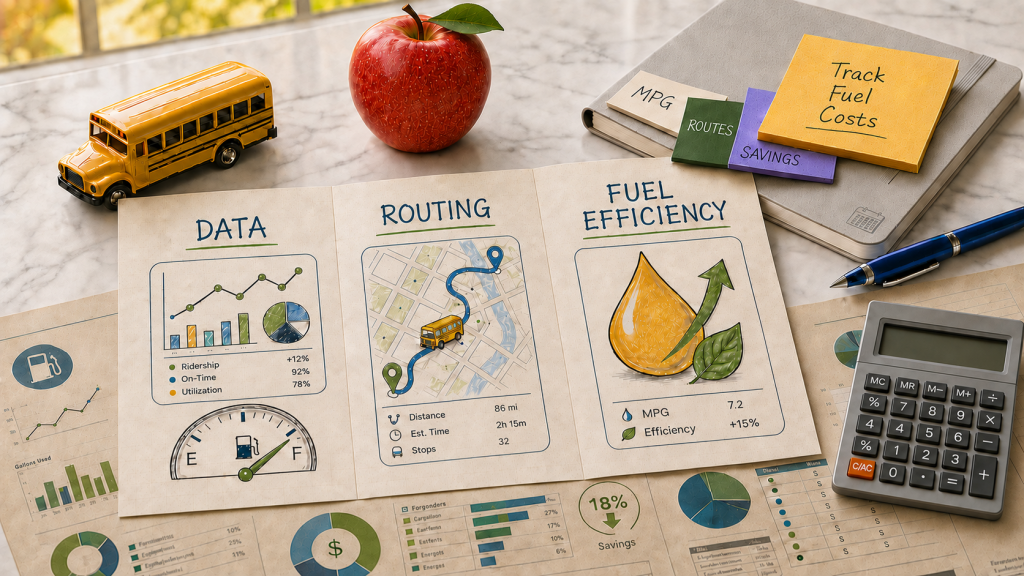
School transportation operations are increasingly turning to routing data, GPS, telematics, maintenance records and analytics tools to reduce fuel use, unnecessary mileage and related operating costs.
Transfinder recently announced that transportation leaders in 30 states cited operational challenges limiting route optimization in the software and hardware through the company’s School Bus Routing Efficiency Poll, with fuel costs being one pain point. The company noted California’s diesel per gallon prices in late May soared nearly 66 percent since April 2025 compared to 26 percent for gasoline, with one district turning to Transfinder routing software to help ensure logistically efficient routes.
“A route is never just a line on a map; it is a financial equation that directly impacts a district’s bottom line,” noted Ron Johnson, director of support operations for Indian Prairie School District #204 in Aurora, Illinois.
“As school districts nationwide grapple with tightening capital budgets, driver shortages and ambitious environmental goals, transportation directors are being asked to do more with less.”

True operational efficiency requires moving beyond reactive management, Johnson said, adding that transportation departments can transform themselves into data-driven strategic assets by leveraging advanced routing analytics, enforcing smart idling policies and optimizing fuel procurement.
Indian Prairie uses Tyler Technologies Versatrans
Routing and Planning with Tyler Drive tablets to analyze its routing practices and ensure reductions in fuel use and vehicle wear. “We positioned our dispatch centers and vehicle garage locations to reduce excessive deadhead miles,” he said. “Miles driven without students on board generate zero operational value while burning fuel and wearing down vehicles.”
The district has ongoing efforts to review outdated routes and changing ridership numbers. “A few years ago, we re-did our school boundaries, significantly reducing the miles driven,” Johnson said. “We also incorporated a practice to reduce idling and multiple stops in the same area. Left-hand turns against heavy traffic, stops placed too close together, routing through highly congested bottlenecks increase idle times, or slow average transit speeds and drives up fuel burn.”
Fuel efficiency in school transportation is fundamentally a systems problem, not just a driver behavior problem, said Craig Berndt, Geotab business segment manager for people transportation.
“A bus burning excess fuel is often a symptom of a route that was designed years ago against student populations and road networks that no longer exist,” he said, adding routing analytics make inefficiencies visible. By overlaying GPS tracking data against planned routes with Geotab’s routing partners, Berndt said patterns emerge quickly such as routes that consistently run 15 percent longer than planned, corridors where two routes shadow each other, and deadhead miles accumulating because a terminal is poorly positioned relative to the first pickup.
Districts taking a data-driven approach to routing optimization typically find 8- to 12-percent mileage reductions in the first year of active management, he noted.
“If you are not focused on efficiency, your routing can quickly overlap and become inefficient,” added Jason Hibbard, supervisor of transportation for the Chenango
Valley Central School District in Binghamton, New York.
“We focus on deadhead mileage. We are servicing multiple out-of-district locations. We constantly adjust routes to limit the time students are missing class time due to transportation and bell schedule conflicts.”
District data shows areas where a diesel bus could be run instead of gasoline to mitigate excessive brake use with the gas buses not having a supplemental exhaust brake, Hibbard said.
Meanwhile, Kathy Calkins, transportation director for North Clackamas School District in Oregon, said the district is using routing analytics to consolidate paths, eliminate excessive deadhead miles and ensure high bus capacity utilization.
Rich Casto, transportation supervisor at Jackson County Schools in West Virginia, agreed. He shared that analytics are playing a strong role in creating shorter,
better and smoother routes.
“When you’re looking at the ability to possibly combine a route without having that eagle’s eye view of mapping and routing with analytics, you really wouldn’t be able to see that without a lot of extra work,” he added.
Kacy L. Davis, Sr., the transportation director at St. Louis Public Schools in Missouri noted routing analytics are central to fuel efficiency “because every mile and every stop has a cost.” St. Louis provides student transportation through a partnership with Zum Services, using realtime GPS, telematics and routing analytics to reduce fuel use, improve route efficiency and enhance service reliability.
“This helps us eliminate outdated stops, reduce deadhead miles, tighten belltime coordination, and remove duplicated service areas which directly lowering fuel use
and operating costs,” said Davis.
Planned Versus Actual Routes
The gap between a planned route and the route a driver actually runs is one of the most underappreciated sources of cost in school transportation, noted Berndt.
Indian Prairie’s Johnson said a route may look flawless on a computer screen, but the divergence between the planned route and the actual path driven stems from
real-world variables.
“Construction zones, localized traffic, substitute drivers relying on historical workarounds, or dynamic student factors like missed stops all create a variance gap,” he said.
Johnson said his Onscreen GPS software allows his staff to review reports for when drivers deviate from the planned route path. Necessary adjustments can be made. St. Louis’ Davis said, “Zum’s platform shows us where buses deviate from planned routes due to construction, traffic, substitute drivers or outdated maps. When we see consistent patterns, we adjust routes, update turn-by-turn directions, and Zum coaches the drivers. This reduces unnecessary mileage without compromising safety.”
Hibbard in New York noted his district’s drivers are the ones on the road everyday. “We can sit in an office and use the best software available. However, when the driver hits the road, the route will not be perfect,” he said. “It takes constant work between the router and the driver to ensure the route is efficient. We use GPS regularly to ensure the driver is following the planned route to the best of their ability.”
West Virginia’s Casto noted it’s crucial to work with the vendors when changes and adjustments are needed. His district utilizes Zonar Systems. “For the most part, routes are routes. You have students and children in locations that you have to travel,” Casto said.
“But you can start to look at where you can combine the stops. Maybe you have another bus or an asset in an area that is a shorter distance to move those students over onto. “We’re in a rural area where you travel out further and deeper,” he continued. “Not all routes are interconnected through other side roads, so sometimes that’s not possible. But when you start to get into the more populated areas, then that’s where that plays in.”
Potholes in the Process
Road conditions also play a major role in fuel burning and maintenance cycles. “Zum’s telematics help us identify rough roads, steep grades and high stop-and-go
corridors that accelerate tire wear, brake cycles and suspension repairs,” Missouri’s Davis said. “Understanding these patterns allows us to reroute buses or collaborate with the city on infrastructure concerns.”
Road infrastructure and its impact on vehicle wear and tear is an area where telematics data can change how districts think about route assignments entirely,
Berndt at Geotab noted. Addressing road infrastructure and vehicle wear, Casto noted his district has examined that against the backdrop of being a rural school system.
“We travel a lot of back roads and secondary roads, so you have to take into consideration road conditions are not going to be what they would be in the inner-city area,” he said. “The biggest benefit of having that analytic option is to look at the route from a bird’s eye view and be able to see that there might a road that’s a little bit better and wouldn’t be as far for the parents to have to come if we have to move a route to stay on a better road.”
Hibbard said it is a daily focus of his staff to consider hills and brake usage, fuel efficiency, or just adjusting the route based on construction and/or traffic.
“When designing routes, we do our best to avoid certain problematic roads,” noted Calkins in Oregon. “However, student safety sometimes makes that unavoidable. To manage this, all buses undergo a comprehensive annual inspection, during which every component is thoroughly checked and maintained. This annual review is crucial, as it allows us to clearly evaluate the specific type of wear and tear each vehicle has experienced over the year.”
Understanding Idling Policies
Meanwhile, idling has a major compounding impact on fuel budgets, tailpipe emissions and public perception, especially when buses are queued near school zones and residential neighborhoods, noted Calkins.
“We address this through clear, enforced anti-idling policies [that are] communicated directly to our drivers during professional development and training,” she said.
“To uphold these standards, with our new tablets, we will utilize automated telematics system alerts. If a bus idles beyond a designated time threshold, notifications will be logged, allowing supervisors to review the data, follow up with the driver and ensure compliance. This strictly limits unnecessary fuel waste and protects air quality around our campuses.”
Chenango Valley Central School District follows New York state policy on not idling on school grounds unless it is excessively cold, Hibbard said.
Jackson County Schools has a 15-minute idling policy. “It’s not a real strict policy, but what having that available, is a conversation that you can have with the driver to point out here’s a place that we can make an improvement, here’s what that
over-idling costs the county in fuel costs. When you start putting those numbers on paper, you can sit down with a driver and look at that. It really hits home,” Casto said.
Vehicle idling is a compounding, costly and avoidablepical school bus can burn up to a gallon of
fuel per hour while idling
“Under Illinois statute, diesel school buses are generally restricted from idling for more than 10 minutes with a 15-minute exemption for passenger comfort,” Johnson said. “While running a bus for 15 minutes so a driver can sit in an air-conditioned cabin is a textbook violation, running that same bus to safely operate a wheelchair lift or to maintain a climate-controlled cabin for a student with severe thermoregulatory issues or a seizure disorder is a legally protected necessity.”
While routing analytics and idle reduction limit the physical volume of fuel burned, transportation directors must also optimize how that fuel is purchased, said Johnson.
“Transitioning from standard credit cards to a specialized government fleet fuel management program such as the WEX fuel card is a critical step in modernizing financial operations,” he added, noting additional benefits such as automating tax exemptions, capturing volume-based rebates, and providing security by utilizing driver PINS and odometer prompts.
Editor’s Note: As reprinted from the August 2026 issue of School Transportation News.
Previous articleRouting Analytics Matter for Fuel Efficiency, Experts Agree
Digital Editions
August 2026
The August issue explores the people, technology and strategies keeping school bus fleets running safely and efficiently. Learn how…
Partner Updates

Norman Public Schools Has All the “Finders” + One Critical Transportation…

The Importance of Streamlined Communication in School Bus Transportation for Safety…
Buyers Guide
Buyer’s Guide 2026
Find the latest vehicle production data and budget reports, industry trends, and contact information for state, national and federal…
Multimedia

(STN Podcast E318) Trying to Make A Difference: 40 Years of Service &…

(Free Webinar) School Bus Rooftop Snow Removal: ROI Tools to Help Decide Which…

(STN Podcast E317) Industry Innovation: 26-Year-Old Contractor Star & Evolving School Bus Tech
Special Reports

Industry Ascension

Helping First-Time Riders Approach the School Bus with Confidence
<img src="https://i0.wp.com/stnonline.com/wp-content/uploads/2025/12/first_alt_FIRST258_5952_wheelchair_in_van.jpg?zoom=3&resize=218%2C150&quality=100&strip=all&ssl=1" alt="A student in a wheelchair being secured in a FirstAlt van. (Photo courtesy of First Student.)" title="Same Goals, Different Vehicles” loading=”lazy”>
Same Goals, Different Vehicles

