

Still in the midst of a liquidity crisis, the U.S. Postal Service needs more revenue and may raise parcel prices even if that means handling fewer packages overall.
“The results this quarter show the strong leverage that pricing can have on results, and pricing is one lever that we have to use now to grow revenue,” said Postmaster General and CEO David Steiner during the USPS Board of Governors open session on Aug. 7, 2026.

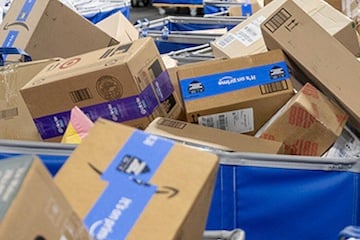
The Postal Service is a key last-mile package carrier. This USPS photo shows several Amazon Prime packages, which the agency handles.
Revenue Growth
The USPS reported $19.9 billion in operating revenue for its third quarter ended June 30, up 6.1% from the same period last year. Its net loss narrowed to $2.5 billion from $3.1 billion.
Shipping and packages generated $8.25 billion in revenue during the quarter, a year-over-year increase of $588 million or 7.7%. Yet package volume declined by 55 million pieces, or 3.4%.
Thus the USPS made significantly more revenue from fewer shipments.
Ground Advantage growth contributed to the increase, as did a temporary transportation-related price increase implemented in April for some parcel services. Relatively higher prices are compensating for declining volume.
“All of the statistics and results show that we have yet to cross the point that we should be changing our pricing strategy, and that we have more price [increases] to take in the marketplace. It would be financially irresponsible of us not to do so,” Steiner said.
This was also true for market segments the Postal Service dominates, such as mail delivery. First-Class Mail revenue, to continue the example, increased 4.3% during the quarter even though volume fell 3.5%.
Prices
Regulation limits how aggressively the Postal Service can raise prices for its monopoly mail products. Still, the quasi-governmental agency has considerably more protection and flexibility than for-profit carriers in the industry.
During his remarks, Steiner compared USPS pricing to supply-and-demand at airlines and grocery stores, where businesses adjust prices to maximize financial returns rather than simply trying to sell the greatest possible quantity.
“Thus far, applying those basic principles has favored raising prices even though there has been a modest decrease in volumes,” Steiner said, equating the USPS to private industry, which operates under different rules.
Ecommerce May Not Save the USPS
Ecommerce Impact
For many years, growing ecommerce package volume appeared to be one way — perhaps the only way — for the Postal Service to offset the decline in First-Class Mail volume and its associated revenue.
In a sense, many merchants thought so too. The USPS has been an attractive carrier for lightweight residential shipments and deliveries to areas where private carriers may impose additional fees, particularly for last-mile deliveries.
The theory was that packages filled trucks, processing facilities, and delivery routes that the USPS was legally required to maintain anyway. If you have a post office in even the tiniest of towns, why not include ecommerce deliveries?
Steiner, however, points out that maximizing parcel volume, or even mail volume, is not necessarily the same as maximizing revenue.
During the June 30 quarter, the USPS handled 55 million fewer packages while collecting $588 million more from those shipments. From the Postal Service’s perspective, that was a favorable trade. And it creates a different incentive that could impact ecommerce shippers.
On the one hand, the Postal Service still needs packages, but its latest results show that it does not necessarily need more of them at any price. If the USPS can collect more revenue while carrying fewer parcels, Steiner has made clear which outcome he prefers.
For ecommerce merchants, this shift in perspective does not make Ground Advantage or other USPS services any less attractive. It does suggest how the Postal Service could change.
Unsustainable Model
Steiner also asserted that while the agency needed more price-setting authority, even a revenue boost could not fix a structurally unsustainable Postal Service.
“As things stand, the Postal Service is expected to be self-sustaining while, at the same time, fulfilling mandates that are inherently unsustainable and do not cover their costs,” Steiner said.
“We need to fix the business model that has produced the 17-year-long imbalance in costs and revenue — and that is going to require Congressional involvement.”
In the meantime, ecommerce merchants should assume that postal package rates could rise again ahead of the holiday peak.
