

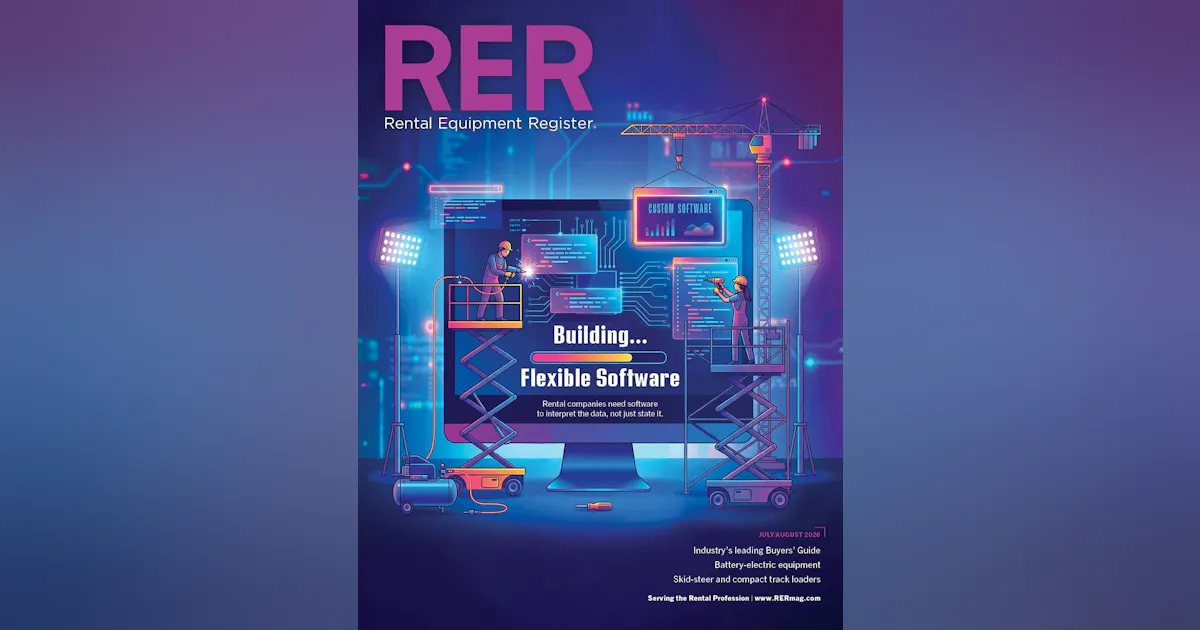
Software is better than ever and provides more information for rental companies than ever before. But, knowing what to do with this fount of information is another challenge, something rental companies continue to wrestle with.
According to most rental leaders interviewed by RER, most important is not just the capacities that the software comes with, but its flexibility and capability to adapt to rental companies’ needs.
While many good software systems come “off the shelf” in a package, they haveto be able to adjust to the needs of a customer to be useful in an ever-changing software environment.
“We require a software partner that is dynamic in terms of system innovation and engineering,” says J.T. Sutton, Region Rents. “This is ‘mission critical’ for our company to compete with the national corporations.”
“Being able to seamlessly integrate with other systems is one of the biggest challenges for us,” says Stephen Bullock, Southern States Equipment. “Our core rental platform is purpose-built and overall strong on the fundamentals, but no industry-specific system does everything. When we identify a gap, the real challenge isn’t just finding a solution for it, it’s finding one we can connect and integrate to our system. Too often the only path is clunky file-based transfers, which severely limits partnership with other specialized providers. What we’re looking for are providers whose systems are built to integrate seamlessly with others, so we can extend our core platform rather than work around it.”
Bullock says its system “handles the fundamentals well – contracts, assets, and multi-branch operations on a single platform. What we want more is a modernized system with self-service reporting, automation, and AI capabilities that reduce manual workarounds, so our team spends its time making decisions rather than wrangling data.”
Rob Wilson, CEO of Stephenson’s Rental Services, reinforces that view.
“With any software provider, we are obviously looking for stability and ease of use,” Wilson says. “However, the best software providers are those that constantly seek customer feedback and invest in development to drive greater productivity and data transparency.”
Angela Mitchell, marketing director of ENCOM Equipment says, “We are looking for true technology partners, not just software vendors. We need platforms that are reliable, easy for our team to use and flexible enough to grow with a fast-moving company. Open APIs and strong integrations are critical. Our rental system, CRM, telematics, website, accounting tools and customer communication platforms should share information without requiring duplicate entry.”
Not to be underestimated is ease of use.
“We want software that is easy to learn, intuitive, and helps make our jobs easier,” says Todd Turner, CEO of PDQ Rentals. “We also value reporting capabilities that can be automatically pushed to users, customizable dashboards, and flexibility, because every rental operation has different procedures and workflows.”
Brian Spilak, CEO of Cooper Equipment Rentals, says there are some absolute non-negotiables when it comes to software partners.
“Access to data is critical,” he says. “Single sign-on is critical. Open architecture that allows us to have access to data from an EPR perspective is critical. And integration, being able to integrate it to the application. We have an eco-system, and those are non-negotiable. It doesn’t matter the type of software, whether it be an AP system or AR system or customer-facing system. If you don’t have any of those things, you’re knocked out of the box right away.”
Of course, large national companies can afford dedicated IT departments, while smaller independents often don’t even have a single full-time IT individual. But, whether it’s one person part-time or a department of experts, rental companies typically have very capable people who help their companies develop IT skills.
“Our managers are highly effective in their respective roles by utilizing the real-time reporting capabilities the system provides,” says Region Rents’ Sutton. “Revenue analysis/ROI, customer income data, and maintenance analytics are leveraged to ensure that Region Rents has the operational agility to optimize every aspect of our business. We welcome all system improvements as they become available to make us better managers.”
Wilson points out the good things Stephenson’s systems provide and how the company is trying to evolve. “Over the past 15+ years, Stephenson’s has transformed its decision-making foundation from gut feel to data-driven decision-making. This has only been possible by having an operating system that allows for easy access to the millions and millions of data records in a way that can be organized and reported to allow frontline employees to make quick decisions. What our operating system is missing is the ability to recommend a decision. We have needed to invest heavily in internally developed systems that use data from the operating system to generate recommendations for our frontline employees.”
ENCOM’s Mitchell expresses similar strengths with ENCOM’s system and the same kinds of frustrations.
“Our operating system does a good job managing the core rental transaction, including contracts, equipment availability, billing, reporting and customer account information,” she says. “We also provide customers with portal access, real-time rental information, weekly on-rent reports and additional transactional reporting.
“Where we want to improve is everything surrounding the transaction. We want a more modern user experience, stronger mobile capabilities and smoother connections between our operating system, CRM, telematics and customer-facing platforms. Information should move automatically from one system to another. Our employees should not have to export spreadsheets, re-enter information or search multiple platforms to understand what is happening with a customer or a machine.”
“We have the ability to move fast, adapt, and make the difficult happen quickly,” says Turner. “We are a ‘say yes’ company, and we need the ability to make adjustments easily because we operate 24/7. Our operating system needs to support that speed and flexibility.”
Telematics is now widespread in the rental industry, and many customers expect the essential services it provides.
“Our mechanics can log in to a single portal that provides comprehensive access to the fleet,” says Sutton. “This tool enables us to plan maintenance in advance, increases our efficiency and reduces machine downtime. The ultimate goal will always be to eliminate costly repairs, extend the useful life, and preserve the residual value of each machine.”
“The same issues exist within our telematics framework as with our operating systems; extreme amounts of data with no clear way to support decision-making for frontline employees and customers,” says Wilson. “As such, we have invested heavily in transforming the data into providing actionable items for both internal staff and customers.”
“Telematics gives us valuable visibility into machine location, operating hours, utilization and service intervals,” says Mitchell. “It helps with asset protection, billing accuracy and maintenance planning. The challenge is that telematics data is often fragmented across different manufacturers and platforms. Our goal is to have normalized data from the entire connected fleet flowing into one operational view. Dispatch, service and rental employees should be able to see location, hours, fault codes and machine condition without opening several different systems.
“Our predictive maintenance capabilities are developing. Today, much of the process is still driven by operating hours, scheduled service intervals, inspections and employee knowledge. We want to move toward true condition-based maintenance, where fault codes, operating patterns and machine data help us identify potential issues before a breakdown occurs. That would allow us to schedule labor, order parts and communicate with customers proactively instead of reacting after a machine goes down.”
Turner also notes that PDQ is proficient at using telematics for accurate billing, notifying customers when a machine is low on DEF, pulling fault codes remotely, and recovering stolen equipment.
“We have adapted to the high-theft environment in Southern California and have developed processes to recover stolen machines quickly because, unfortunately, that is a weekly occurrence,” Turner adds. “We are about to revamp our predictive maintenance processes because the old ways of doing things no longer keep up with today’s equipment. Water in fuel is a common issue that can destroy fuel systems, so early detection and notification are critical. We are also beginning to incorporate AI technologies into our service department to help technicians troubleshoot common problems as those tools become available.”
Spilak talks about integrating telematics into Cooper Equipment Rentals’ workflow.
“We’ve invested heavily in telematics over the last five years,” he says. “We’ve got a billion dollars’ worth of assets right now and about 85 percent of our fleet would be telematic and the one thing we do very well with telematics is integrating it into our operational workflow. But it’s not just GPS locations. Years ago, that was the main thing but now it’s the bottom of the list in terms of what we use telematics for. Integrating it into our workflows for our customers and our teams, we do a good job with that. Integrating our data warehouse and being able to integrate it into some of the other systems we have. Customers are increasingly expecting this type of visibility, and we do a nice job with that.
“We can do a better job at predictive maintenance. I think we’re getting all the fault codes, we’re getting all the ambient hours, we’re getting all the scheduling pieces in there. We’re doing a lot on the AI front. I think AI on the predictive maintenance side will be big. We do the basic stuff using telematics, but predictive maintenance is what we envision, fixing the equipment before the customers even knows there’s a problem.
“That’s the utopia. If we show up and the customer says, ‘What are you doing here?’ and we say, ‘This machine is going to have an issue in two days.’”
One of the most important tasks for rental software is management the rental fleet.
“Effectively managing the rental fleet of equipment is core to the success of any equipment rental company,” said Stephenson’s Wilson. “While we have done a lot of work to understand our equipment utilization, we continue to develop tools to facilitate quicker decisions on purchases, disposals and relocating equipment between regions. In addition, we are exploring AI options to assist with bulk inventory control/management, freeing up staff time to focus on delivering best-in-class customer service.”
While dispatch has become widely computerized in recent years, the human part of it is still important.
“Dispatch should be able to optimize decisions based on geography, equipment type, truck capacity, customer priority, requested delivery windows and changing field conditions,” says Mitchell. “Many of those decisions still depend heavily on the experience and judgment of the dispatcher. We want technology that strengthens that judgment with real-time routing, live driver updates, accurate delivery ETAs and automated customer communication. When conditions change, routes should be easy to adjust without creating a chain of phone calls between dispatch, drivers, salespeople and customers.”
Mitchell points out that the goal is not to remove the human element. It is to give the dispatch team better information so they can make faster decisions and communicate more effectively.
“Dispatch is an area that requires perpetual improvement,” says Sutton. “Fuel is expensive, so wasted motion costs the company real dollars! Logistics software must be utilized to the fullest, but we believe this is where the human factor plays a major role. Highly trained employees behind the controls are required to maximize efficiency.”
“In rental, we do a lot at the last minute,” says Spilak. “It’s not scheduled weeks in advance or months in advance. Right now, [in the middle of the day], I can look at any one of our branches, they would have tomorrow morning semi-booked. But that’s going to change in the next three hours. And frankly they’re going to get a curveball tomorrow morning and it will all change again. So, we still have our team of dispatchers that are constantly moving with changing demands. But they’re being augmented by these tools that help them, saying this is the best branch to get the equipment from, and then get it delivered the fastest.
“So dispatching is dynamic. Customers are expecting an Amazon-like field, and that Amazon field is better communication. When are you going to be here, are you late, etc. Gone are the days when our field reps spent the whole morning fielding orders, and all afternoon chasing orders. And so now with the technology, it allows the customers to understand where they are in the delivery cycle. I think AI is a big part of that. Just getting mobile tools into the hands of our drivers makes a world of difference.”
Artificial intelligence is a growing part of the rental industry and most rental companies are just scratching the surface to see what it can do.
“The biggest potential we see for AI is on the service side of our operations,” says Sutton. “AI could have the ability to reduce diagnostic times and advise technicians, helping increase turnaround time on repairs. There is an app that allows you to view a machine through your device’s camera and have it highlight parts in real time and give service notes on repairs. Not having to scour parts and service manuals would save a great deal of time.”
“AI is already playing a meaningful role in our sales, marketing and administrative operations,” says Mitchell. “We use it to support research, communications, reporting, process documentation, data organization and the development of internal resources. It allows our team to move faster and spend more time on higher-value work.
“The next opportunity is using AI with operational data. We see potential in demand forecasting, inventory positioning, maintenance alerts, dispatch optimization, lead prioritization, customer communication and identifying unusual activity before it becomes a larger issue.
“We also see value in an internal AI assistant that can securely answer questions using our own procedures, fleet data and company knowledge. The goal is not to replace employee judgment. It is to give employees better information and eliminate repetitive work so they can make stronger decisions.”
“AI is one component of our broader Connected Worksite strategy, where connected equipment, data, digital workflows and intelligent software work together to help customers improve safety, productivity and sustainability,” says Tony Leopold, chief technology and strategy officer, United Rentals. “It is helping us put decades of fleet expertise directly into customers’ hands. Equipment Agent guides customers to the right machine for their job through a conversational experience, reducing equipment selection time by 70 percent.
“We deployed it in the ChatGPT store this year as the first equipment rental application available there, meeting customers in the tools they already use to plan work. Our broader focus is to leverage AI tools and AI-driven insights to create digital experiences built around the speed and complexity of today’s jobsites. Internally, we’re leveraging AI and modern data platforms to accelerate development, uncover operational insights and improve how we build and deliver digital solutions.”
Increasingly machines are connected, enabling them to build efficiencies and even enhance environmental sustainability.
“With telematics on all of our large equipment, we are able to provide back-office and shop staff with real-time information to better support our customers,” says Wilson. “On the customer side, we have developed systems that enable customers to easily view the status, usage and emissions data for their equipment. Customers can set up alerts for temperature, humidity, low charge, underused equipment, etc., to ensure their sites are proactively managed.This connectedness is also a meaningful enabler of our sustainability goals; giving both us and our customers the visibility needed to actively reduce environmental impact at the jobsite level.
“Sustainability is becoming an increasingly important lens through which we evaluate software and technology decisions. We are actively looking for partners who can help us build tools that make it easier to track, report on, and continuously improve our environmental performance; and to pass those capabilities on to our customers.”
It all sounds relatively easy. Most rental companies have similar goals, but the path is more complicated and expensive than it sounds.
“Our biggest frustration is the age of the underlying architecture. Our system runs on a legacy AS/400 platform, and that shows up in a lot of ways,” says Bullock. “Extracting the right data usually means building a report from scratch or submitting a support ticket rather than pulling it ourselves, and it lacks the modern conveniences most mainstream ERPs treat as standard. Integration is one of the sharpest pains. There is an API, but it’s built on [an older protocol] and we’ve had vendors who simply can’t work with it, which leaves file-based transfers as the practical path with all the limitations that come with it.
“We understand a deeply industry-specific ERP won’t do everything perfectly, but the gap versus a modern platform is significant, and it severely limits our ability to integrate with other specialized software providers.
“Our greatest frustration is that many strong systems still operate independently,” says Mitchell. “Each platform may perform its primary function well, but connecting the systems can be expensive, slow or limited by the vendor’s integration capabilities.
Duplicate data entry remains a significant issue. Reporting can also become more complicated than it should be when information is stored in multiple places or formatted differently across systems.
“We would like to move faster on integrations and automation without every improvement becoming a major custom development project. Growing companies need systems that can adapt quickly rather than forcing the business to operate around the limitations of the software.”
“Customers are expecting digital experiences and data is becoming as important as the iron we’re delivering,” Cooper’s Spilak says. “I don’t think the winners in this space are the ones that own the biggest fleets. I think it’s going to be the companies that help the customers work smarter. And I think technology plays a big role in that.”
