

As I have reported here, the legal technology company Clio is making a big push into the judiciary. It wants to develop AI tools to make judges’ jobs easier, and it has even trademarked the phrase “judiciary-grade AI.”
To that end, Clio has made two key hires: Pablo Arredondo, the Casetext cofounder who joined Clio as senior vice president, judiciary, to lead the company’s development of technology for the courts, and Bridget M. McCormack, the former Michigan Supreme Court chief justice and American Arbitration Association president, who is now general manager, judiciary, where she will lead market and commercial strategy for the judiciary business.
Clio also acquiredLearned Hand, a startup that builds AI exclusively for judges and courts, giving it an existing product already in use in a number of courthouses to build on.
But even as it does all this, a key question is whether courthouse doors are even open to Clio or any other AI provider? For that matter, are judges even permitted to use AI?
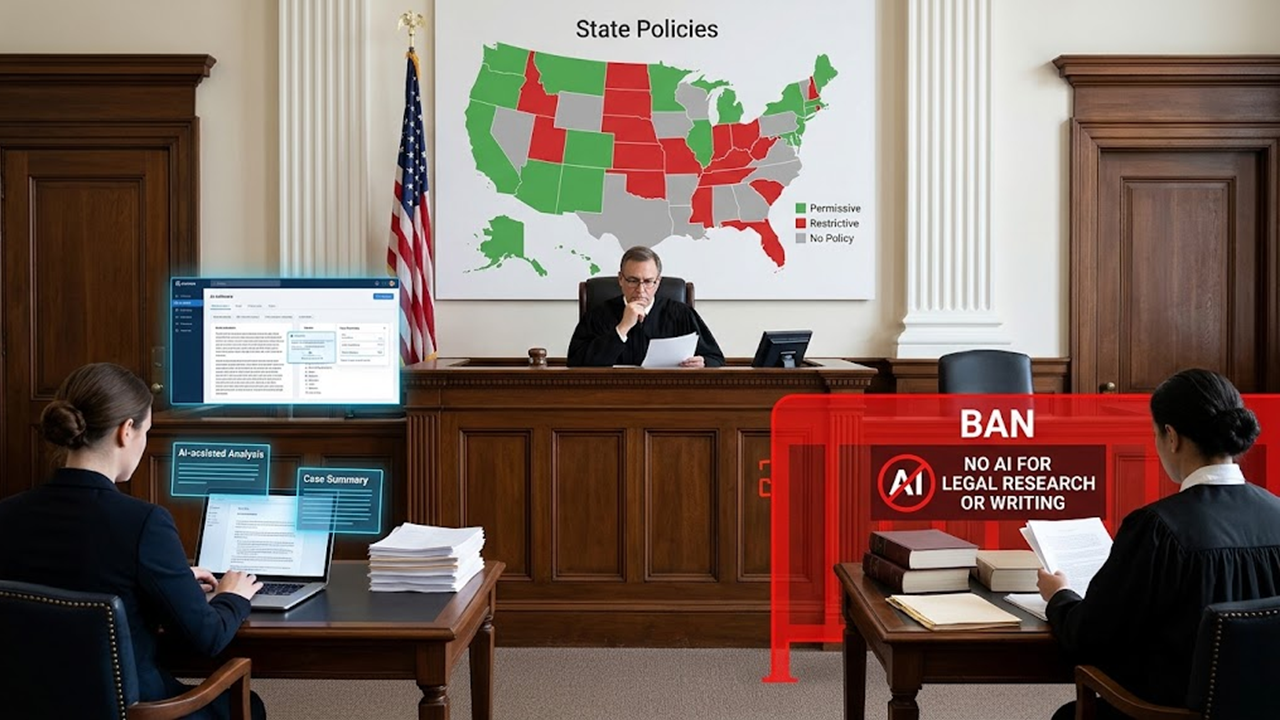
Turns out the answer varies widely by state, with at least one state outright banning AI use by its judges, and others having either more open policies or no policies at all.
The state that bans AI use by judges happens to be the one I live in – Massachusetts. Its policy, the most restrictive in the country, bans the use of AI for legal research, legal writing or other legal work.
The ban applies to judges, clerks, law clerks, interns, and other court employees and contractors.
The Massachusetts Supreme Judicial Court adopted the guidelines, “Interim Guidelines for use of Generative AI,” in November 2025. The guidelines say that they “will be refined and modified as more becomes known about Generative AI.” A check last week with the court confirmed that there have been no modifications.
Curious about the policies in other states, I enlisted ChatGPT to help me conduct a 50-state survey, and then had Claude double-check the results. I also performed my own research. The results are below.
If you know of additions, changes or errors in anything below, please let me know (ambrogi-at-gmail.com).
Some Notes on the Findings
The full findings are in the chart below. But first, a few comments and notes.
First off, to be clear, this survey does not cover policies directed solely at attorneys or litigants. The focus is solely on policies directed toward judges, magistrates, law clerks, court administrators, and the like.
It encompasses four categories of policies:
- Binding rules and administrative policies. These are requirements applicable to AI use by judicial officers or court employees.
- Judicial ethics guidance. These are advisory in nature, such as advisory opinions, ethical best practices, or other interpretations of judicial conduct obligations.
- Administrative guidance and principles. Official recommendations, operational guidance, or frameworks for evaluating and implementing AI.
- No statewide policy. No publicly available, statewide AI-use instrument was located.
An important distinction is between using AI to assist judicial work and using AI to exercise judicial judgment. Some states explicitly authorize AI-assisted research and drafting while prohibiting judges from delegating decisions to AI. Others restrict the tools or circumstances in which judicial employees may use AI at all.
No National Consensus
One clear conclusion from the survey is that there is no single national approach to judicial AI use. Rather, the policies fall along a spectrum, ranging from detailed rules to broader ethical statements to nothing at all.
As noted, Massachusetts is the most restrictive, prohibiting gen AI for legal research, legal writing, and other legal work. It permits the use of AI for administrative tasks.
Rhode Island is an example of an approach that centers on ethics. Its detailed judicial guidance explores specific problems presented by AI, but the Supreme Court expressly makes the guidelines advisory rather than binding.
But there is one point on which these policies agree, which is that judges cannot delegate their judgment to AI. While AI may assist a judge, it may not serve as the decisionmaker.
Even when policies allow AI-generated research, summaries, or drafting, judges retain responsibility for independently understanding the record, applying the law, and deciding the case.
Another issue that comes up frequently is the need for verification of legal citations and factual assertions. These obligations are especially important given the risk of hallucinations, or even of hard-to-spot inaccuracies.
Some policies distinguish between public AI systems and private, approved or specially secured systems. Policies commonly prohibit judges and employees from entering nonpublic case information, internal judicial deliberations, sealed material, or personally identifying information into a public chatbot.
Some states – including Arizona, New York, Pennsylvania, South Carolina, Utah and Virginia — have adopted controls over which tools court personnel may use. Several also require training, supervisory permission, or disclosure of an employee’s AI use to the judge for whom the employee works.
In the end, the biggest question is not whether judges may use AI for scheduling, meeting notes or routine correspondence. Rather, it is whether they may use AI to analyze evidence, summarize testimony, conduct legal research, draft opinions, or assist with factual findings.
With Clio moving into the judiciary market, others are sure to follow. As they do, distinctions about how judges and court personnel may or may not use AI become increasingly important.
State-by-State Findings
This table reviews publicly available state court policies, rules, administrative directives, and guidance governing the use of generative AI by judges and judicial personnel as of Oct. 30, 2026. As I said, I used ChatGPT to perform the research and compile the table, then had Claude check the results, and then supplemented it with information I found on my own.
Note that “not identified” does not necessarily mean no policy exists, just that none was found. If you see gaps or mistakes, please let me know and I will update the chart.
- Policy = operative court rule or administrative restriction.
- Guidance = judicial ethics advice or official recommendations.
- Principles = institutional framework that does not necessarily prescribe permitted tools or tasks.
- Developing = committee, proposal, or not-yet-effective rule.
| State | Status | Summary of Findings | Original Sources |
|---|---|---|---|
| Alabama | Not identified | No publicly available statewide policy specifically regulating AI use by Alabama judges or judicial branch personnel was identified. | — |
| Alaska | Policy | The Alaska Court System’s Policy for Court Staff and Judicial Officers on Using Artificial Intelligence (Version 1.2, June 2026) applies to all judges and court staff. It permits AI and gen AI for official work, including legal research using tools designed for legal applications, such as Westlaw Precision. Users must independently verify outputs, legal citations, and factual claims, and review for bias. Only information suitable for public disclosure may be entered into AI tools; confidential, privileged, and personally identifying information is prohibited. Court personnel may create free AI accounts using court email addresses but may not use personal subscriptions for work. Downloading AI applications onto court-owned devices is prohibited. AI may not be independently used to generate transcripts or notes of court hearings, and AI assistants must be removed from hearings. Employees preparing work for judges must consult their judges about proposed AI tools, except for specified standard applications. Mandatory AI training and signed policy acknowledgments are required for all judicial officers and court staff. | Policy for Court Staff and Judicial Officers on Using Artificial Intelligence at the Alaska Court System (Version 1.2, June 2026). Alaska Court System FY2025 Annual Report |
| Arizona | Policy and guidance | Arizona Code of Judicial Administration § 1-509 governs AI and large-language-model use by court personnel. It provides for approved technologies, restricts disclosure of nonpublic information, and requires responsible review. Separate judicial ethics guidance addresses judges’ obligations. Notably, in August 2026, the Supreme Court declined a proposed categorical prohibition on judges using AI. “Instead, the Court will keep letting judges test AI tools in a careful, controlled way,” it said. A different rule obligates judges to learn the benefits and risks of technology, including AI, well enough to use it responsibly. | § 1-509; Ethical Best Practices; August 2026 AnnouncementAriz. R. Sup. Ct. 81, ACJC Canon 2, Rule 2.5. |
| Arkansas | Policy | Arkansas Supreme Court Administrative Order No. 25, adopted Dec. 11, 2025, focuses on protecting confidential court data rather than regulating how AI is used. Section 1 applies to everyone participating in the court system. It warns that some gen AI tools retain and train on submitted data, distinguishes public large language models from private ones, and cautions that disclosing confidential or sealed information may violate court rules, statutes, the Rules of Professional Conduct, and the Code of Judicial Conduct. Section 2 prohibits Administrative Office of the Courts staff, all court clerks and their staff, and anyone else with access to internal CourtConnect, from intentionally exposing the courts’ internal data to a gen AI system that uses a public LLM. Those covered may seek approval from the Supreme Court’s Automation Committee for AI research projects. The order does not address which tasks judges may use AI for, and its prohibition does not name judges expressly. | IN RE ADOPTION OF ARKANSAS SUPREME COURT ADMINISTRATIVE ORDER NO. 25. ARTIFICIAL INTELLIGENCE |
| California | Rules and guidance | Effective September 2025, Rule 10.430 requires courts that permit AI to adopt policies covering court staff and judges’ nonadjudicative duties. Standard 10.80 separately addresses judicial officers’ adjudicative use through recommended safeguards, including verification and confidentiality. Local court policies may impose additional restrictions. | Rule 10.430; Standard 10.80 |
| Colorado | Developing | The Colorado Supreme Court established a Legal Technology Advisory Committee in 2025 to develop AI guidance covering judicial officers, lawyers, and court users. Draft materials address judicial independence, AI-assisted drafting, and confidentiality. Adoption of the drafts as binding judicial-use policy was not verified. | Advisory Committee; June 2026 Draft Materials |
| Connecticut | Policy | Judicial Branch Policy 1013, the Artificial Intelligence Responsible Use Framework, effective February 1, 2024, governs evaluation, procurement, deployment, and official use of AI. Its gen AI provisions require authorization for use and restrict entry of nonpublic information. | AI Responsible Use Framework |
| Delaware | Policy | An October 2024 Interim Policy on the Use of Generative AI by Judicial Officers and Court Personnel permits controlled use of approved tools, subject to training, confidentiality, accuracy checks, and judicial accountability. AI cannot replace a judge’s exercise of judgment. | Official Interim Policy |
| Florida | Not identified | No statewide policy specifically governing judges’ own gen AI use was identified. June 2026 amendments to Rule 2.515 address the accuracy of legal authorities cited in court filings but do not constitute an internal judicial AI-use policy. | — |
| Georgia | Recommendations | The Judicial Council’s ad hoc committee produced Artificial Intelligence and Georgia’s Courts, examining AI risks and recommending governance measures for the judiciary. The committee report does not itself establish an operative statewide rule authorizing particular judicial uses. | Committee Report (copy) |
| Hawaii | Policy and judicial guidance | The chief justice approved a memorandum for justices and judges addressing technological competence, impartiality, and AI-generated content. The judiciary also adopted September 2025 AI Guardrails requiring supervisory approval, judiciary-approved tools, protection of nonpublic information, and verification of AI output. Both documents appear in appendices to the judiciary’s December 2025 report. | Official Report and Appendices |
| Idaho | Adopted principles | The Idaho Supreme Court formally adopted judicial-branch AI guiding principles in 2026. They emphasize human control of judicial decisions, fairness, security, transparency, and accountability. An October 2026 report contains implementation recommendations but does not require courts to adopt particular AI systems. | Adopted Principles; Court Announcement |
| Illinois | Policy | The Illinois Supreme Court’s AI policy, effective January 1, 2025, applies to the judiciary and other court participants. AI-assisted work remains subject to ethical obligations. Judges and court personnel must verify outputs, protect sensitive information, and retain responsibility for judicial functions. | Supreme Court AI Policy |
| Indiana | Internal policy reported | Indiana Supreme Court Innovation Committee minutes from 2025 document an Office of Judicial Administration policy for internal responsible AI use, with further trial-court guidance planned. An Indiana Court Times article indicates these policies have been adopted. | Innovation. Committee Minutes
From Guardrails to Toolkit: AI Governance Committee Delivers Model Policies for Indiana Trial Courts |
| Iowa | Adopted; effective 2027 | On July 21, 2026, the Supreme Court adopted Chapter 27, Judicial Use of Artificial Intelligence Tools, effective January 1, 2027. It governs judges and adjudicative assistants, preserves independent judicial decision-making, requires verification of legal and factual sources, establishes approval and disclosure requirements for assistants, and requires approval of tools processing judicial case information. Not yet effective as of October 30, 2026. | Chapter 27; Adoption Order |
| Kansas | Developing | Supreme Court Administrative Order 2025-CM-017 established an AI committee responsible for recommending internal judicial-branch policies and vetting court AI uses. The order establishes a governance process rather than comprehensive rules for judges using gen AI. | Administrative Order 2025-CM-017 |
| Kentucky | Limited administrative controls | AI-related controls have been identified within Kentucky’s judicial information-technology operations. The Supreme Court adopted a broader court information-technology acceptable-use policy in 2025, but that order is not a comprehensive gen AI-specific rule for judges. No published statewide judicial gen AI policy was verified. | 2025 IT Acceptable-Use Policy |
| Louisiana | Nonbinding guidelines | On October 3, 2025, the Louisiana Supreme Court Technology Commission issued Generative Artificial Intelligence Guidelines. They discuss research, summarization, routine drafting, and administration, while cautioning against general-purpose AI systems for sensitive work. The guidelines reject autonomous judicial decisions and discourage reliance on AI for substantive legal analysis or case outcomes. | Technology Commission Guidelines |
| Maine | Not identified | No publicly available statewide court policy specifically addressing judges’ or judicial employees’ gen AI use was located. | — |
| Maryland | Internal policy | The Maryland Judiciary has guidelines for acceptable use of AI tools and platforms by personnel, including data protection, secure accounts, and responsible use. Its employee handbook references an AI acceptable-use policy, but the operative text appears to reside on restricted CourtNet. The publicly available material does not establish every restriction applicable to judges. | Judiciary Employee Handbook |
| Massachusetts | Restrictive policy | The Supreme Judicial Court’s November 12, 2025 interim guidelines apply to judges, clerks, law clerks, employees, and contractors. Generative AI may not be used for legal research, legal writing, or other legal work. Limited administrative uses are permitted only with specified tools, privacy safeguards, and public information. Outputs must be independently verified. | Official Interim Guidelines |
| Michigan | Judicial ethics guidance | State Bar of Michigan judicial ethics Opinion JI-155 addresses judges’ obligations to understand AI technologies and consider the risks AI creates for judicial duties. It provides ethics guidance rather than a statewide tool-approval or usage policy. | Ethics Opinion JI-155 |
| Minnesota | Policy — principles | Judicial Council Policy 704, effective November 1, 2024, applies to judicial officers and judicial branch employees. It establishes governance principles of responsibility, equity, traceability, reliability, and controllability. It is a high-level policy rather than a detailed list of permitted judicial AI tools or prompts. | Judicial Council Policy 704 |
| Mississippi | Not identified | No statewide policy prescribing judges’ or judicial staff’s use of gen AI was located. | — |
| Missouri | Not identified | No publicly available statewide policy specifically governing gen AI use by judges and judicial branch personnel was located. | — |
| Montana | Not identified | No published statewide policy governing gen AI use by Montana judges or judicial employees was identified. Some local courts have adopted AI-related filing requirements primarily directed at attorneys and litigants. | — |
| Nebraska | Not identified | No publicly available statewide judicial-use policy was located. Internal court technology or information-security restrictions may still apply. | — |
| Nevada | Judicial guidance | The Administrative Office of the Courts published Artificial Intelligence: A Guide for Judicial Officers. It discusses AI-assisted drafting, legal-text analysis, and summarization; recommends treating AI as supplementary to judicial judgment; and emphasizes verification, confidentiality, fairness, hallucinations, and deepfakes. The guide is educational rather than a comprehensive mandatory-use rule. | AI Guide for Judicial Officers |
| New Hampshire | Not identified | No statewide rule or policy specifically governing gen AI use by judicial officers or court personnel was located. | — |
| New Jersey | Adopted principles | On January 23, 2024, the Supreme Court approved its Statement of Principles for the New Jersey Judiciary’s Ongoing Use of Artificial Intelligence. Judges and staff may use AI for selected support tasks, such as preliminary gathering and organization of information, but AI must not replace independent judicial decisions. The principles also address fairness, bias, transparency, security, and accountability. | Supreme Court Statement of Principles |
| New Mexico | Specific prohibition and interim guidance | A March 16, 2026 memorandum from the chief justice prohibits third-party AI note-taking applications during in-person or virtual meetings. It applies to justices, judges, and judicial branch employees, with possible disciplinary consequences. A separate May 2026 communication circulated interim AI guidelines for legal professionals. The note-taking restriction is not a blanket prohibition on all gen AI use. | Official Memorandum and Communication |
| New York | Policy and judicial ethics opinion | The Unified Court System’s Interim Policy on the Use of Artificial Intelligence, effective October 2025, covers judges and nonjudicial employees. It requires approved products, training, protection of sensitive case information, verification, and independent judicial judgment. In September 2026, Advisory Opinion 26-133 concluded that judges may use an approved private AI system to summarize transcripts as an aid to fact-finding, provided they verify the summaries and retain decision-making authority. | Unified Court System AI Policy; Advisory Opinion 26-133 |
| North Carolina | Local orders; statewide policy not identified | No statewide judicial-use policy was identified. Some local courts have adopted rules concerning AI in proceedings. A December 2025 Cabarrus County Superior Court order addresses AI-related disclosure, evidence, and litigation practices, primarily concerning parties and lawyers rather than judges’ internal use of AI. | Cabarrus County Administrative Order |
| North Dakota | Policy | The Supreme Court adopted Administrative Order 36, Use of Generative Artificial Intelligence, effective May 18, 2026. It governs authorized court uses of gen AI, differentiates tools according to information sensitivity, requires verification and human accountability, and confirms that judicial conduct obligations continue to apply. | Administrative Order 36 |
| Ohio | Judicial ethics guidance | The Ohio Board of Professional Conduct published its 2026 AI Ethics Guide for Lawyers and Judicial Officers. It addresses judicial independence, impartiality, technological competence, verification, confidentiality, and staff supervision. It is an ethics resource rather than a statewide administrative rule specifying approved AI tools. | 2026 AI Ethics Guide; Supreme Court AI Resource Library |
| Oklahoma | Not identified | No publicly available statewide rule, administrative directive, or judicial ethics guidance specifically prescribing judges’ or judicial personnel’s gen AI use was identified. | — |
| Oregon | Not identified | No statewide internal judicial-use policy was identified. Oregon courts have published public-facing guidance for people using AI in court matters, but such material does not establish policies for judges or employees. | Example of Public-Facing AI Guidance |
| Pennsylvania | Policy | On September 9, 2025, the Supreme Court approved an Interim Policy on the Use of Generative Artificial Intelligence by Judicial Officers and Court Personnel, effective December 8, 2025. It governs judicial and staff use, including approved technologies, protection of confidential information, review of output, and continued human responsibility for judicial work. | Supreme Court Order and Policy (copy) |
| Rhode Island | Judicial ethics guidelines | On June 17, 2026, the Supreme Court adopted Interim Guidelines for the Ethical Use of Generative AI by Rhode Island Judicial Officers. They address independent judicial decision-making, fabricated authorities, bias, improper fact-gathering, ex parte communications, and staff supervision. The guidelines expressly state that they are advisory and do not carry the force of law. | Supreme Court Order and Guidelines |
| South Carolina | Policy | A March 25, 2025 Supreme Court interim policy applies to judicial officers and employees. Only gen AI tools approved by the Supreme Court or Court Administration may be used for judicial branch duties. The policy emphasizes confidentiality, accuracy, and independent human review. | Supreme Court Interim Policy |
| South Dakota | Judicial branch employee guidance | The Unified Judicial System issued Generative AI Guidance for court employees. It identifies possible uses, including drafting and summarizing, and addresses factual errors, confidentiality, and human review. Because its language is principally directed to UJS employees, its precise applicability to judges has not been established. | UJS Generative AI Guidance (NCSC copy) |
| Tennessee | Not identified | No publicly available statewide policy specifically prescribing gen AI use by Tennessee judges or judicial employees was identified. | — |
| Texas | Advisory recommendations | Supreme Court Advisory Committee materials discuss judges’ and law clerks’ use of gen AI, including draft orders, output verification, sensitive information, tool vetting, and staff supervision. These are committee recommendations rather than a verified statewide judicial-use rule. Separate local orders address AI use by lawyers and litigants. | Supreme Court Advisory Committee Materials |
| Utah | Policy | The Judicial Council adopted Interim Rules on the Use of Generative AI in October 2023. They address judicial officers’ and court employees’ use of AI, authorized tools, training, staff disclosure, confidentiality, and independent responsibility. Later revisions further regulated approved tools, training, and case-related information. I can find that the rules were implemented, but I am not finding the full text. | Judicial Council Materials; Proposed Revisions |
| Vermont | Policy | Supreme Court Administrative Directive 38, Policy on Artificial Intelligence, amended October 6, 2025, governs AI use in Vermont’s judiciary. It preserves judicial independence and judicial conduct obligations, requires verification of AI-generated work, and establishes procedures for evaluating proposed uses and managing confidentiality and security risks. | Administrative Directive 38 |
| Virginia | Policy | The Supreme Court’s Rules for Generative AI Use, initially effective June 6, 2024 and amended May 7, 2025, regulate gen AI within the judicial system. They cover authorized tools, staff and judicial obligations, training, confidentiality, security, and verification of generated content. The amended rules also prohibit DeepSeek on court devices. | Supreme Court Rules for Generative AI Use |
| Washington | Adopted principles and guidance | The Board for Judicial Administration approved an AI Statement of Principles on February 21, 2025, emphasizing human judgment, fairness, access to justice, privacy, transparency, and security. Additional operational discussions appear in Judicial Information System Committee materials. The statement is a principles document rather than a comprehensive enforceable judicial-use policy. | AI Statement of Principles; Committee Materials |
| West Virginia | Judicial ethics opinion | Judicial Investigation Commission Advisory Opinion 2023-22 discusses judges’ use of gen AI. It recognizes possible use as an aid to research or written work while emphasizing judges’ personal responsibility for decisions, independent verification of information and citations, and appropriate supervision of staff. It is an ethics opinion, not a comprehensive administrative policy. | Advisory Opinion 2023-22 |
| Wisconsin | Proposed rule withdrawn | A February 2026 petition proposed Supreme Court Rule Chapter 76, governing gen AI use by judges, staff, lawyers, and litigants. On October 15, 2026, the Supreme Court granted the petitioner’s motion to withdraw and dismissed the petition. The proposed rules therefore did not take effect. No alternative statewide judicial-use policy was identified. | October 15 Supreme Court Order; Original Rule Petition |
| Wyoming | Not identified | No publicly available statewide policy directed specifically to judges’ or court employees’ gen AI use was located. Court orders concerning fabricated AI-generated citations in party filings do not establish a statewide judicial-use rule. | — |
