

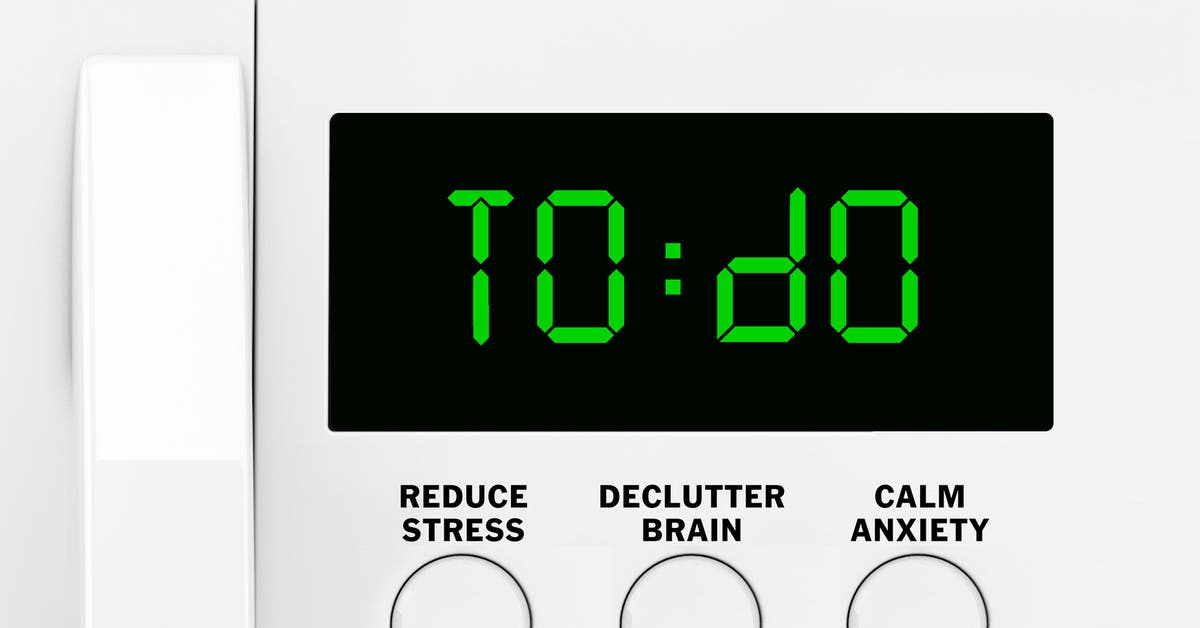
Lately, my social media feeds have become overrun with unwanted, algo-fed posts urging me to optimize every second of my existence for maximum productivity. “Break your limits!” they tell me in aggro marketing slogans. “Level up your life!” Oftentimes, they claim that the best way to achieve all of that overachieving is by adding another app, interface, or wearable to my personal stockpile of digital tech.
But I think I’ll stick to my low-tech solution for getting more accomplished while experiencing less anxiety: the timer on my microwave.
Whenever I’m feeling overwhelmed by all of the tasks on my to-do list, I march over to the microwave and set its timer for five minutes. Then I just start dealing with whatever is top of mind or immediately in front of me: dirty dishes in the sink, an email I’ve been meaning to reply to, and so on.
It’s fine if that one thing doesn’t take exactly five minutes, or if it’s not the single most crucial thing on my proverbial plate. It’s also fine if I keep resetting the timer in five-minute increments to keep myself going. The important part is that I’m unsticking myself from my procrastination and decision paralysis and getting the ball rolling. An object in motion tends to stay in motion, which means that, in time, I’m more likely to get around to everything that warrants my attention.
Another important part, I’ve learned, is that in doing so I’m not relying on my phone or laptop for help.
The microwave’s alarm is loud and annoying enough that I can’t ignore it. I have to physically move across a room or two to turn it off. It isn’t sitting right there in my pocket, easily silenced and therefore largely ineffective. It also doesn’t tempt me to avoid my obligations by falling down a YouTube rabbit hole.
Am I alone in my preference for an old-fashioned fix for the modern-day dilemmas of cognitive overload and mental clutter? Hardly. When I polled my Wirecutter colleagues about the unconventional ways they boost their moods and manage their productivity, the makeshift methods they recommended, with great enthusiasm, were almost all analog ones: Writing things down by hand. Turning an everyday object into a special talisman. Finding an IRL activity that helps you focus.
The science concerning this is even clearer. When you want to simultaneously increase your productivity and your sanity, a tech-centric strategy probably isn’t the answer. In fact, there’s a good chance it may just make things worse.
“There’s good research showing that some analog tools — like writing by hand or using a paper planner — can be more effective than digital tools in certain situations, especially for focus and memory,” Sarah Pressman, a professor of psychological science at the University of California Irvine, said in a phone interview. “When you pick up your phone to check your calendar or a productivity app, you’re also opening the door to a flood of distractions — texts, social media, emails — which can quickly derail your attention and mental energy.”
Another issue with tech-driven options is precisely the fact that they solve your problems for you. “We sometimes prefer effort over ease and convenience [because] people often derive meaning and satisfaction from investing effort,” Ximena Garcia-Rada, an assistant professor of marketing at Texas A&M University, said in an email interview. “Despite our heavy reliance on digital devices … I think these analog strategies work not in spite of the effort they require, but because of it.”
Still skeptical? Here are just a few of the kooky ways that we at Wirecutter take control of our to-do lists and manage our workflows when the going gets tough — and why experts say that, when you’re feeling stuck, they really are the way to get going.
When in doubt, write it out
Several Wirecutter staffers told me that their favorite way to calm or focus their minds is by putting good, old-fashioned pen to paper.
“I keep long, running to-do lists on my Notes app, but when I’m feeling in the weeds and anxious, I go back to paper and pen and make shorter, prioritized lists for the day with both work and home tasks,” writer Samantha Schoech says.
Production manager Nicki Koetting loves to boost her mood with a different list-related ritual. “I keep a ‘done’ list where I write down everything I’ve done that day — not what I need to do, because I have my to-do list app, Todoist, for that — but things I actually accomplished, including non-work things like cleaning the kitchen and making dinner,” she says. “It makes me feel really productive to physically write out everything.”
To make the habit extra enticing, Nicki uses a fancy-ish Field Notes Memo Book and a Blackwing pencil (both picks of ours) for the task.
Perhaps more than any other analog hack, the simple act of writing, even if it’s just to reiterate the info you already have on your phone, has been shown to offer a plethora of physiological benefits.
“Writing by hand engages memory, motor, and visual systems in a way that can support deeper processing and focus,” Pressman says. “It also slows you down just enough to help organize your thoughts more clearly, which can be helpful for managing stress. In specific contexts like journaling or gratitude writing, there’s even some evidence it can improve mood or reduce perceived stress or pain.”
Garcia-Rada adds that physically crossing items off a to-do list is one of her personal favorites. “It’s such a small thing, but it gives me a real sense of closure and accomplishment that’s often missing when I swipe something away on a screen or delete a card from a project management app,” she says.
As for me, I’m not sure I could fully function without my “life” notebook, where I write down everything, including shopping lists, vacation itineraries, weekly meal plans, head counts for birthday parties and Thanksgiving dinner, and of course, daily and weekly to-do lists. Almost all of that information simultaneously exists in a Google Doc or on my Google Calendar, but as Pressman noted, the act of writing (or rewriting) my plans helps calm me and allows me to better commit it all to memory.
Reduce mental clutter by reducing your visual clutter
When deputy search director Sebastian Compagnucci bought a robot vac, he didn’t do so for mental health reasons. So he was surprised when his Roborock Q5 Max+ (a former top-pick robot vacuum) wound up greatly improving his work-from-home mindset.
“I’m very triggered by visual noise. My mind is constantly churning, and I can’t really settle if the clutter is too much,” Sebastian says. “The visual noise of just seeing all the dust bunnies all over the floor has reduced tenfold since I started using the robot vac.”
“Visual clutter can increase cognitive load, making it harder to focus and think clearly,” Pressman says. “Over time, that mental strain can elevate stress hormones like cortisol, contributing to feelings of irritability, overwhelm, and even helplessness — factors that are strongly linked to anxiety and decreased performance.”
Of course, if you think lessening your visual clutter would help, buying a pricey appliance isn’t a must. We recommend plenty of less expensive storage options, such as a cute laundry hamper that you can repurpose as a kids’ stuffie holder, perhaps, or a lidded, rattan box from Muji that can work as an all-purpose catchall in any room of your house.
When I do my five-minute-timer thing, I often dedicate the first five minutes to putting things back where they belong. Once I’ve taken care of that visual clutter, it’s much easier for my mind to start focusing on everything else.
Find your workflow with a special (if quirky) habit
When writer Kimber Streams is facing a tight deadline, they have a unique secret weapon that helps them take their productivity up a notch. “It’s something only an unhinged Wirecutter writer with too many keyboards would do,” they told me, “but I will sometimes swap keyboards if I’m feeling stuck.”
Kimber’s keyboard trick is an effective productivity hack, Pressman says, precisely because they turn to it only in certain situations.
“One of the problems with smartphones is that they’re designed to do too many things. Every time you pick one up to do something simple, like check your calendar, you’re also exposed to dozens of other cues,” she explains. “That constant cognitive switching drains mental energy and makes it harder to stay focused. Sometimes, using a single-purpose analog tool like a paper planner or a kitchen timer can protect your attention and boost productivity.”
Kimber’s primary duties at Wirecutter include testing keyboards and laptops, but they bought the NuPhy Air75 V2, one of our previous Bluetooth keyboard picks, specifically for their own use in time-crunch situations.
“It works with everything — phone, tablet, computer — and it’s portable enough to travel with since it’s a low-profile mechanical keyboard,” Kimber explains. “But it’s also nice enough to plop on my desk if I need to lock in and write something. The tactile feedback and it being a ‘special writing keyboard’ help my brain, I think.”
With a dedicated object, Pressman says, “your brain will anticipate that something specific is about to happen, and it starts to prepare your body accordingly.” (If you ever took Psych 101: It’s just like with Pavlov’s dogs.)
The thing itself does not have to be part of your work setup, the way Kimber’s keyboard is. Writer Claire Wilcox likes to change into a pair of clogs whenever she feels creatively stuck.
Cut out distractions by, um, literally cutting things?
The winner of the Wackiest Hack Award goes to writer Abigail Bailey. When she needs to tame her anxiety and focus on a specific task, she sets her mind right by breaking out her chef’s knife and doing what she calls “kitchen-prep, knife-work stuff.”
As Abigail explains, “I’m like, ‘I’m getting a damn pineapple and breaking the whole thing down.’ Using a sharp knife on a tricky job means I have to really focus. Plus, I get a little treat to snack on at the end.”
Bananas (sorry, pineapples) as that may sound, Pressman says there’s precedent for it. “When we’re stressed out, it’s always going to be helpful if you can really focus deeply on something unrelated,” she says.
For many people, that other activity might be something simple and low-stress, like going for a walk or taking a shower. In fact, this phenomenon is commonly called “the shower principle” or “the shower effect.” Studies have shown that doing something mentally unchallenging that gives your mind license to wander can lead to bursts of newfound inspiration and creativity.
But for other folks, like Abigail, Pressman says that a wandering mind can actually backfire, because it creates space for worry and anxiety to creep in. When that occurs, going the other way and doing something unrelated that requires hyper-focus can be more of a help. (Sometimes, instead of chopping hard-rind fruit, Abigail cues up a TED Talk video and takes notes, which has the same effect of putting her into a state of deep focus — plus, it’s another pen-and-paper hack.)
I’m still occasionally lured into believing that I’m just one tech-driven trick away from “Supercharged productivity!” But when I start thinking that way, I know that it’s probably because I’m feeling stressed or discombobulated and in need of a reset. A walk around the block or another five minutes with my microwave usually does the trick.
This article was edited by Megan Beauchamp and Maxine Builder.
Meet your guide
What I Cover
Unlike many of my colleagues, my job isn’t about being an expert in one product category. Instead, I write about how to get the most value, longevity, and enjoyment out of the stuff you already own (or are thinking about buying) across all of our product categories. One day I might interview a dermatologist about the pros and cons of lanolin, and the next I might smoke a turkey with the founder of New York Times Cooking.
Advertisement
